The Revolution's Most Universal Export Wasn't Liberty. It Was the Metre — and the Clock It Killed — Woody Magazine, Jul. 14, 2026
The Revolution's Most Universal Export Wasn't Liberty. It Was the Metre — and the Clock It Killed
On Bastille Day, as France meets Spain in a World Cup semifinal, consider this: the same 1795 law that handed the world the metre quietly buried a tidier invention — the ten-hour day.
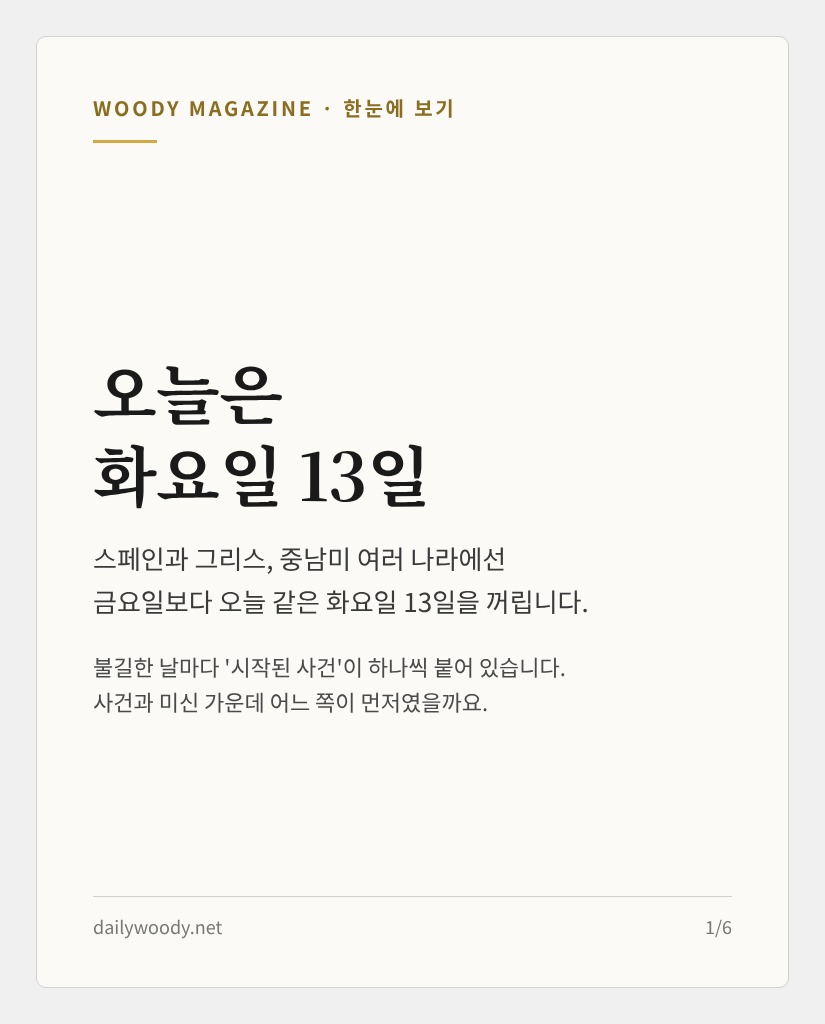
Today is July 14, Bastille Day. In 1789, Parisians stormed the Bastille and lit the fuse of the French Revolution; France has kept the date as its national day ever since. By a small coincidence, this July 14 also finds the French national team in Dallas, meeting Spain in a World Cup semifinal (kickoff comes at 4 a.m. the next morning in Seoul). The tricolour flies twice over.
Yet the Revolution's most widely adopted legacy is neither liberty nor equality nor the flag. It is the notch on the ruler at your elbow: the metre. And here is the part almost no one mentions. The same Revolution did not stop at length. It decimalised time itself. On a true revolutionary clock, the day held ten hours, and noon read five.
The Day That Ran Ten Hours
The revolutionaries did not intend merely to unseat a king. They meant to remake time. From 24 October 1793, France kept a new calendar. A week ran ten days, not seven — a décade. The twelve months were renamed for nature; the height of summer became Thermidor, from the Greek for "summer heat." (The "Thermidorian Reaction" that toppled Robespierre takes its name from that very month.)
The clock went decimal too. Ten hours to a day, a hundred minutes to an hour, a hundred seconds to a minute — exactly 100,000 seconds from midnight to midnight. Noon fell at 5.00. Parisian clockmakers actually built the things; several survive in the Musée des Arts et Métiers. Some pocket watches carried decimal time on one face and the old twelve hours on the other — a quiet record of people forced to read both at once.
The Twin Project: Building the Metre
The same hand redrew length. "One law, one weight, one measure," the government promised. The trouble was the standard. Until then a "foot" was the king's forearm or a local custom; cross one town and its length changed.
So the revolutionaries pried the standard loose from the human body and pinned it to the planet. The metre was defined as one ten-millionth of the distance from the North Pole to the equator, along the meridian through Paris. The reference was no longer a monarch's limb but the size of the Earth. To fix it, someone had to measure the Earth. In 1792 the astronomers Jean-Baptiste Delambre and Pierre Méchain began surveying the meridian from Dunkirk to Barcelona by triangulation — a labour that ran roughly six to seven years.
Here the story brushes against today. That survey was delayed by war between France and Spain. The two nations went to war on 7 March 1793, and Méchain — who had to take part of his measurements on Spanish soil — found himself stranded. France's national metrology laboratory (LNE) records that the war and the Terror slowed his triangulation. The very survey that produced the metre was halted by a Franco-Spanish clash. Two hundred and thirty-three years later, the two countries meet again — this time in a semifinal.
For all that effort, the metre it produced wasn't even exact. Satellite data later put the pole-to-equator distance at about 10,002,290 metres, which makes today's metre roughly 0.2 millimetres shorter than its original definition — mainly because the survey misjudged the shape of the Earth. Building that standard also broke a man. Méchain, working the southern leg, found a discrepancy in his own measurements he could never resolve, and hid it; the error tormented him for the rest of his life. In 1804 he went back to Spain to correct it and died there of a fever. The standard drawn from nature was itself slightly wrong about nature. And still, that slightly wrong metre went on to conquer the world.
One Law, Two Fates
So why did the metre live while the ten-hour clock vanished? The fork has an exact date.
18 Germinal, Year III — 7 April 1795 on the Gregorian calendar. A single law passed that day did two things at once. It gave the metric system its first legal footing, and in the same breath it ended the mandatory use of decimal time. The law that launched the metre also buried its twin. The metric system was confirmed in France on 10 December 1799, a month after Napoleon's coup. The decimal calendar hung on a little longer, until Napoleon restored the Gregorian calendar from 1 January 1806.
Why the More Rational One Died First
It seems backwards. Decimal is the cleaner system; dividing by ten and a hundred beats the tangle of twelve and sixty. And yet the more rational option died first.
The answer is not rationality but the cost of tearing out what is already installed. Changing length and weight took little more than distributing new rulers and scales — and the reward was vast: trade and science that crossed borders. Time, by contrast, was everywhere already. Every clock, every astronomical table, every navigation chart was reckoned on twelve hours and sixty minutes. It ran deeper still — church bells, market openings, the dinner hour, "an hour's walk," "see you in fifteen minutes." To adopt decimal time, people had to distrust a sense of time built since childhood by labour, prayer and sleep. The old clock was irrational on paper and indispensable in life.
The lesson is blunt: a standard does not win by being right. It wins when what is already in place is cheap enough to replace. Decimal time was right, but there was too much to tear out; the metre, right or not, had far less standing in its way and a far larger prize behind it.
The metre didn't win by being more natural. It simply had less old machinery to tear out than time did.
The Revolution Lost at Time, but Won at Money
That 1795 law had three children, in fact, not two. It raised the metre, killed mandatory decimal time — and opened the way to decimal money. Pre-revolutionary French currency was an arithmetic nightmare. One livre held 20 sous; one sou, 12 deniers. To add a sum you carried once at twelve and again at twenty. Britain's pounds, shillings and pence were knotted in the same 20-and-12 tangle. The sums came easily only to the schooled; those who could not do them were forever short-changed.
The Revolution swept it away with a single franc of 100 centimes. This time it stuck. Unlike the metre, decimal money met little resistance, and it spread across the world. Even Britain, which clung to its 240-pence system to the last, finally crossed over on Decimal Day, 15 February 1971.
So three siblings, born of one 1795 law, met different ends. Length and money conquered the world; only time crawled back to its old seat. The difference was the same each time. Old money was painful and easy to replace; time was inconvenient yet lodged too deep to move.
Beyond the Earth — and One Last Irony
The metre kept winning. In 1875 seventeen nations signed the Metre Convention, and it became the international standard; today about 95 percent of humanity lives in metric countries. The metre even outgrew the planet that defined it. In 1983 the world redefined it once more — as the distance light travels in a vacuum in 1/299,792,458 of a second. The unit built by measuring the Earth is now carried on a beam of light. A standard that once looked down at the planet now looks up at the stars.
The last irony sits in the country hosting today's match. The United States signed that 1875 Metre Convention early. Yet it still buys milk by the gallon and drives in miles — one of the few nations never to adopt it for everyday use. The turf in Dallas, where France plays Spain, is laid out in metres by FIFA rule. The metre conquered the world, but not the country co-hosting this World Cup.
Today France honours the ideals the Revolution left behind: liberty, equality, the tricolour. But the thing that Revolution planted most widely was no slogan. It is a span of length stamped on the ruler in your hand. And its short-lived twin left a lesson of its own: being right is not enough. To survive, a thing has to be worth the cost of change.
A standard doesn't win by being more rational. It wins when what's already in place is cheap enough to replace — which is why decimal time, tidier than the metre, died first.
- Source ↗ LNE (French national metrology) — History of units (survey delayed by the Franco-Spanish war)
- Source ↗ NIST — Meter (1983 redefinition by the speed of light)
- Source ↗ BIPM — Metre
- Source ↗ National Geographic — How the French Revolution created the metric system
- Source ↗ Britannica — French republican calendar
- Source ↗ Wikipedia — £sd and currency decimalisation (Decimal Day, 1971)

댓글
댓글 쓰기