Seoraksan's Average Peak Is Today, Judged From the Ticket Booth
Woody Magazine
We write the things that aren't news
Oct. 17, 2026 (Sat.)
Seoraksan's Average Peak Is Today. Korea's Weather Service Calls It From the Ticket Booth
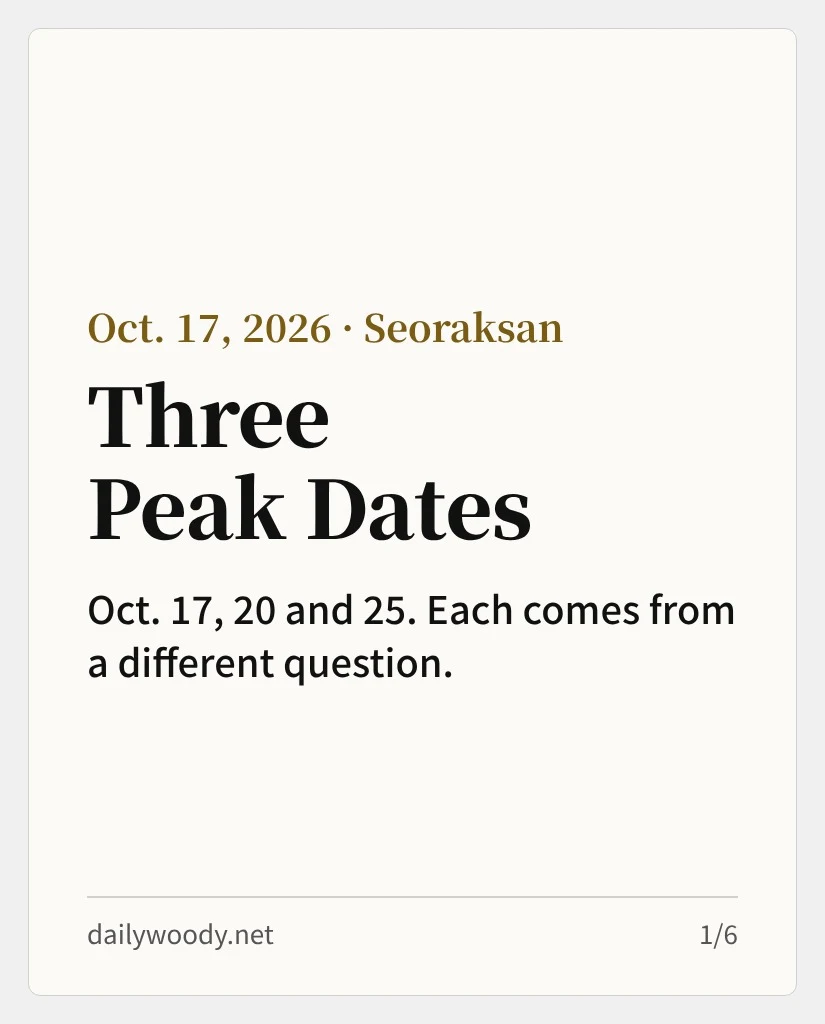
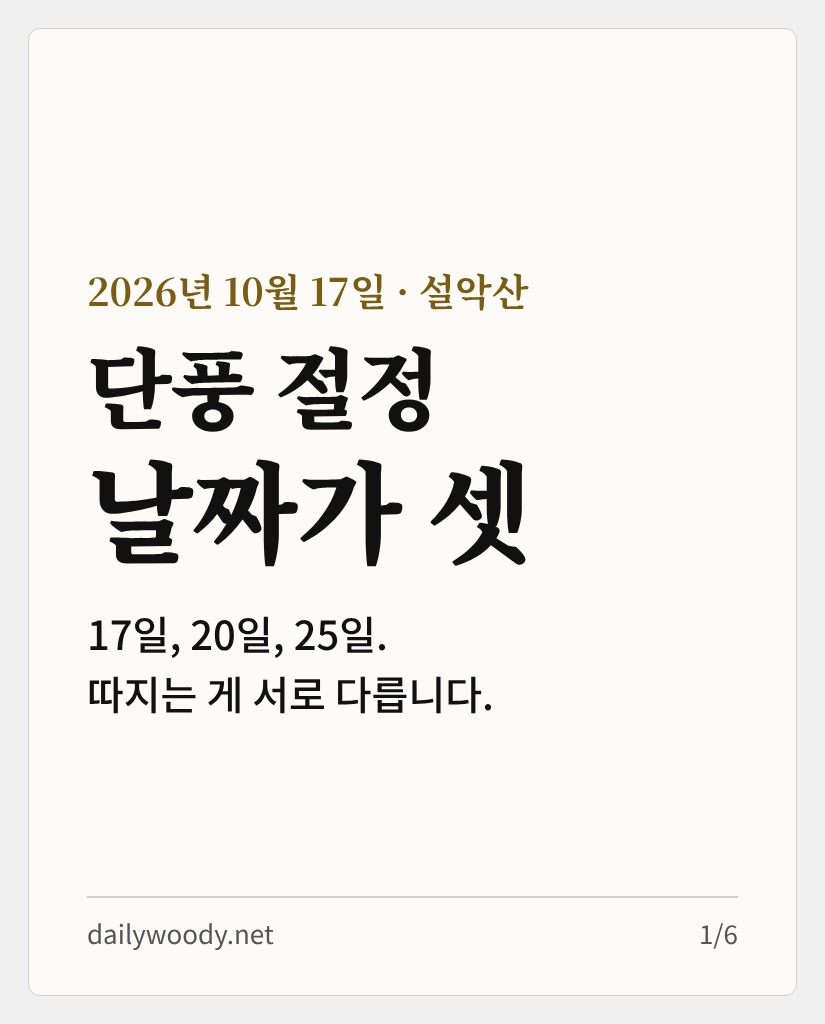
Search for Seoraksan's peak foliage date and you get three: Oct. 17, Oct. 20 and Oct. 25. Each comes from a different question.
At a Glance
This story in six cards.Swipe to see more →



Anyone planning a trip to Seoraksan this weekend has probably searched for the peak date and come away confused. Seoraksan, a national park in South Korea's northeast, seems to have three peak dates. Some sites say Oct. 17. Some say Oct. 20. Others say Oct. 25. It is natural to assume that two of them are mistakes.
That does not follow. Picture a student whose test score rises a little every day. One school sets its pass mark at 50, another at 80. The student is the same, but the acceptance letters arrive on different days. Autumn color works the same way on a Korean mountain, creeping down from the summit a little more each day. The date depends on where someone draws the line.
Twenty percent, then 80
The Korea Meteorological Administration, the national weather service, declares a mountain's "first foliage" when about 20 percent of it has turned, starting near the summit. It declares the peak at about 80 percent. This year Seoraksan's first foliage came on Sept. 28, four days earlier than last year and exactly on the long-term average.
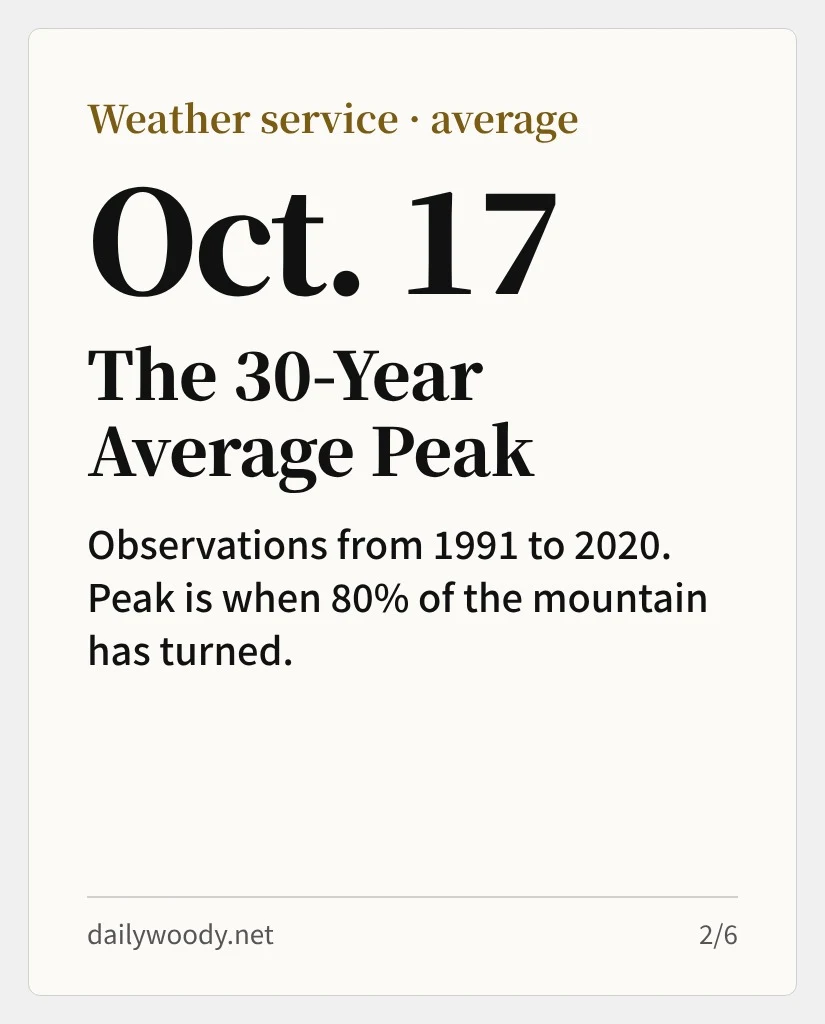
That average comes from 30 years of observations, 1991 through 2020. By that record, Seoraksan's first color arrives on Sept. 28 and its peak on Oct. 17. On the long-term averages, the gap from 20 to 80 percent is 19 days. This year began on schedule, and the weather service recorded the peak a day early, on Oct. 16.
Where the weather service stands
The place where that 80 percent is judged appears in a photo caption. When the agency's Gangwon regional office announced Seoraksan's first foliage on Sept. 28, the caption named it: near the ticket booth at Sogongwon, an entrance on the park's eastern side.
For another mountain, the agency has spelled out what an observer does at such a spot. At Gyeryongsan, a mountain in central Korea, the Daejeon regional office checks three maple trees where a nature trail begins near Donghaksa temple. Then it looks out from the temple toward the Ssalgaebong ridge to judge the mountain as a whole. A person stands in a fixed spot and judges the slope by looking.
Seoul's method is plainer still. The capital's maple season is officially decided by a single maple beside the Seoul Weather Observatory in the Jongno district. The tree is more than 120 years old, and a sign in front of it marks it as the standard tree for seasonal observation. In November 2024, a YTN weather presenter reported from beside it that a week earlier fewer than 20 percent of its leaves had turned, so Seoul had not yet officially recorded its first foliage. The street trees could blaze red; the record would wait for that one maple.
There is a reason the spots stay fixed. Seasonal observation exists to compare regions and to follow climate change over decades. The weather service needs a date it can set beside last year's, and a different vantage point would break the comparison. Hikers entering at Sogongwon today pass close to the spot where the agency looks at Seoraksan every year.
The 50 percent that counts leaves
Oct. 20 belongs to the Korea Forest Service. On Sept. 22 it published its foliage forecast map for 2026, putting the peak for Seoraksan's maples on that date. Its peak means something different: the point at which at least half the leaves on the observed species have turned.
The two agencies differ on more than the threshold. They count different things. The weather service looks at the whole slope; the forest service looks at trees, species by species. That is why its dates split even within a single mountain. At Juwangsan in the southeast, it expects maples to peak on Oct. 26, ginkgoes on Oct. 29 and oaks on Nov. 6. The forest service and the National Arboretum have kept these plant records with public arboretums across the country since 2009, a separate ledger from the weather service's.
Korea is hardly alone in this. A survey in the Vermont Monitoring Cooperative's 1998 annual report asked fall foliage spotters what share of a hillside had to turn before it counted as peak. Their answers ran from 50 to 100 percent, and the study did not arrive at one standard method. The same report describes forest monitoring on Mount Mansfield, where observers returned to the same viewpoints with a tripod, a level and a compass so that each look matched the last.
The 25th is a forecast
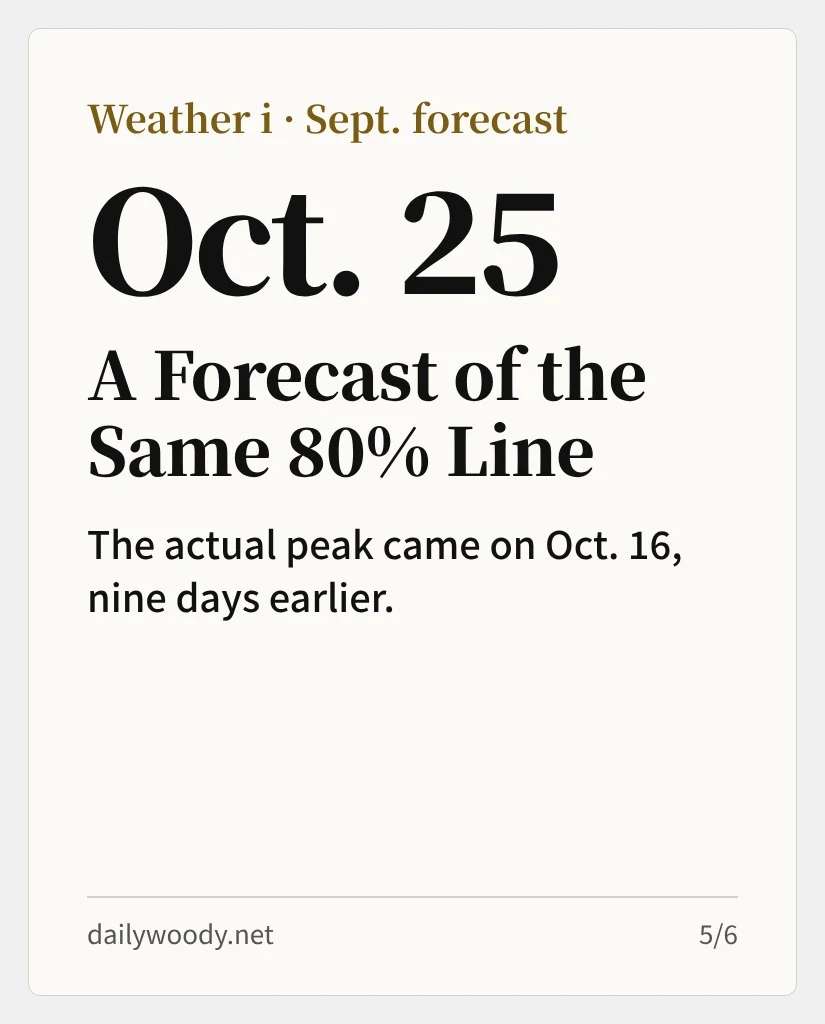
Oct. 25 comes from Weather i, a private forecasting company. In early September it predicted Seoraksan's first color around Oct. 3 and the peak on Oct. 25, using the same 80 percent line as the weather service.
On the first date, the forecast missed. The weather service logged first foliage on Sept. 28, five days before Weather i expected it. Its Oct. 25 peak came nine days after the weather service's observation on Oct. 16.
Here the three dates part ways. Because the private forecast shares the weather service's line, it can be checked against the weather service's observation. The forest service's Oct. 20 answers a different exam altogether, and disagreeing with the weather service does not make it wrong.
Today is the average, not the answer
Last year Seoraksan peaked on Oct. 24, a week behind the average. This year's color started on time and peaked a day early, on Oct. 16.
The weather service posts its calls on the agency's Korean-language Weather Nuri site under its famous-mountain foliage page, with photos for all 21 mountains it tracks. The weekend weather is another variable: YTN's Oct. 15 forecast had rain moving in from the northwest early Sunday and spreading nationwide.
The three dates a hiker carries to Seoraksan today come from three different questions. The weather service draws its line at 80 percent from a spot near the ticket booth. The forest service draws its line at 50 percent, tree by tree. A private company tries to say in advance when the same 80 percent line will be crossed. It is one student, two examiners and one forecaster. The dates may differ, but there is only one mountain.
Sources
- Source ↗ Gangwon Regional Office of Meteorology, press release on Seoraksan's first foliage (Sept. 28, 2026, in Korean)
- Source ↗ Daejeon Regional Office of Meteorology, webzine, autumn 2025 issue (in Korean)
- Source ↗ Korea Meteorological Administration, open data portal, seasonal observation notes (in Korean)
- Source ↗ Korea Meteorological Administration, Weather Nuri foliage status page, Seoraksan peak photo (taken Oct. 16, 2026, checked Oct. 17, in Korean)
- Source ↗ Gukje News, forest service peak forecasts for major mountains (Oct. 10, 2026, in Korean)
- Source ↗ Kyongbuk Ilbo, forest service peak forecasts for Juwangsan and Palgongsan (Oct. 15, 2026, in Korean)
- Source ↗ YTN, Weather i foliage forecast (Sept. 4, 2026, in Korean)
- Source ↗ YTN, live report from the Seoul Weather Observatory's standard maple (Nov. 8, 2024, in Korean)
- Source ↗ Seoul Metropolitan Government Media Hub, visit to the Seoul Weather Observatory (Aug. 9, 2024, in Korean)
- Source ↗ YTN, weekend weather and Bukhansan first foliage (Oct. 15, 2026, in Korean)
- Source ↗ Vermont Monitoring Cooperative, 1998 annual report, foliage spotter survey
- Source ↗ Segye Ilbo, foliage status and peak forecasts as of Oct. 16 morning (Oct. 16, 2026, in Korean)

댓글
댓글 쓰기