Dennis Ritchie, 15 Years On: Oct. 12 Is the Day He Was Found
Woody Magazine
We write the things that aren't news
Oct. 12, 2026 (Mon.)
Dennis Ritchie, 15 Years On — Oct. 12 Is the Day He Was Found
The obituaries gave different dates for his death. His longtime employer declined to give one at all.
In Three Lines
- Fifteen years ago today, Dennis Ritchie, the creator of the C programming language and co-creator of Unix, was found dead at his home in New Jersey.
- Obituaries disagreed on when he died, by as much as four days.
- Nothing about his death is in question. He lived alone, and the company never gave a date.
When we turn on a phone, the name that comes to mind is the company that made it, if any name comes at all. Nobody thinks about what starts running underneath. And why would we? It is the same with a light switch: you flip it without picturing the wiring inside the wall.
Dennis Ritchie ran that wiring. Born in Bronxville, New York, in 1941, he studied physics and applied mathematics at Harvard and joined AT&T's Bell Labs in 1967. There, with his colleague Ken Thompson, he built Unix, an operating system: the base program that tells a computer's parts what to do. To write Unix, he designed a new programming language. That language was C.
Oct. 12 is the day he was found
Most references list his death as Oct. 12, 2011, and it is easy to see why. Brian Kernighan, a Princeton computer scientist who worked with him at Bell Labs, gives that date in a memorial the National Academy of Engineering published in 2016. The Guardian's obituary gives it too.
The New York Times put it differently. Ritchie, the paper reported, was found dead on Wednesday at his home in Berkeley Heights, New Jersey. Oct. 12, 2011, was a Wednesday. His brother Bill told the Times that Ritchie lived alone and had been frail for several years after treatment for prostate cancer and heart disease.
The first word came from Rob Pike, a former Bell Labs colleague then working at Google. That Wednesday, Pike posted on Google+ that he had just heard Ritchie had died at home "this weekend," after a long illness. The weekend before was Oct. 8 and 9. When The Economist ran its obituary in November, it gave the date as Oct. 8.
The company was more cautious still. Alcatel-Lucent, which owned Bell Labs at the time, confirmed the death to The Associated Press but would not say when he died or what caused it. A spokeswoman said the company was trying to reach his family. The AP fell back on his Bell Labs biography and wrote only that he died a month after his birthday.
With no date of death made public, the only firm date was the day he was found. Through obituaries and memorials, it hardened into the anniversary.
A program that didn't care which machine it ran on
The date is not the only thing that is hard to see. His work was built to stay out of view from the start, and the reason lies in what C was for.
When Unix first ran in late 1969, it was written in assembly language, a language tied to one particular machine. By 1973, Ritchie and Thompson had rewritten it in C. Kernighan described it as something never done successfully before: an entire operating system written in a high-level language that people could read.
The payoff came when Unix moved. To carry the system to a computer with a different design, Kernighan wrote, you needed to do little more than move the C compiler. That is the program that translates C into the language of a given machine. Move one translator, and the rest of the code came along largely untouched.
That may not sound like much of a breakthrough. Fair enough. The better C worked, the less anyone had to think about it. Programmers stopped worrying about the hardware underneath, and the people using their programs never needed to know C existed. Good wiring is the kind nobody opens the wall to check.
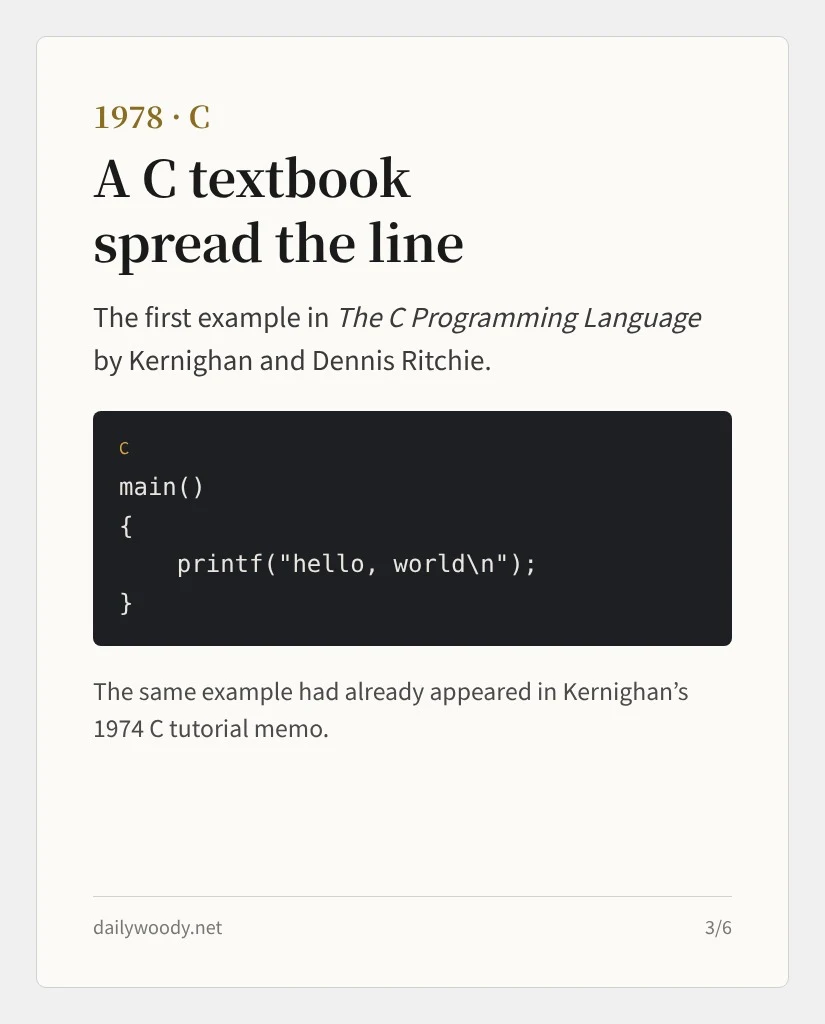
From there it spread. The book Ritchie wrote with Kernighan in 1978, The C Programming Language, became known by their initials, K&R, and was translated into more than two dozen languages. The AP noted in its obituary that Unix and its offshoots, including Linux, run on corporate servers and even mobile phones. Kernighan wrote that most of the world's computers run Unix or something built to resemble it. The phone we pick up in the morning is one of them.
"Everywhere inside"
Steve Jobs had died the week before. Ritchie's death landed beside a wave of tributes to Jobs and was largely lost in it. Pike told Wired that Ritchie's influence was greater, yet the public did not even know who he was.
Paul Ceruzzi, a historian of computing, put it to The Washington Post in plainer terms. Ritchie was not a household name, he said, but anyone who could look inside a computer with a microscope would see his work everywhere.
Ritchie kept his own name in the background too. Kernighan remembered him as someone who always passed the credit along. His example was the acknowledgments in Ritchie's 1996 history of Unix:
Read each unclear "we," he advised, as "Thompson, with some assistance from me."
We remember people by what we can see. What Ritchie laid down was wiring in the walls. People go looking for wiring when it breaks. His hasn't.
On the Side
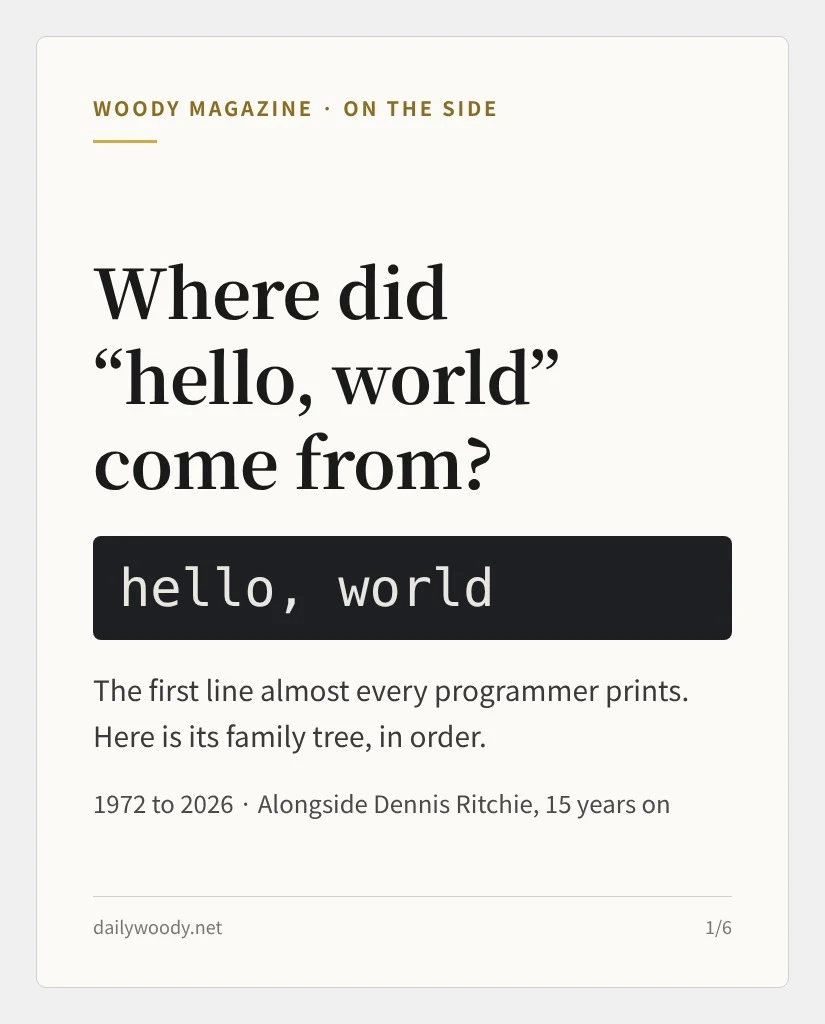
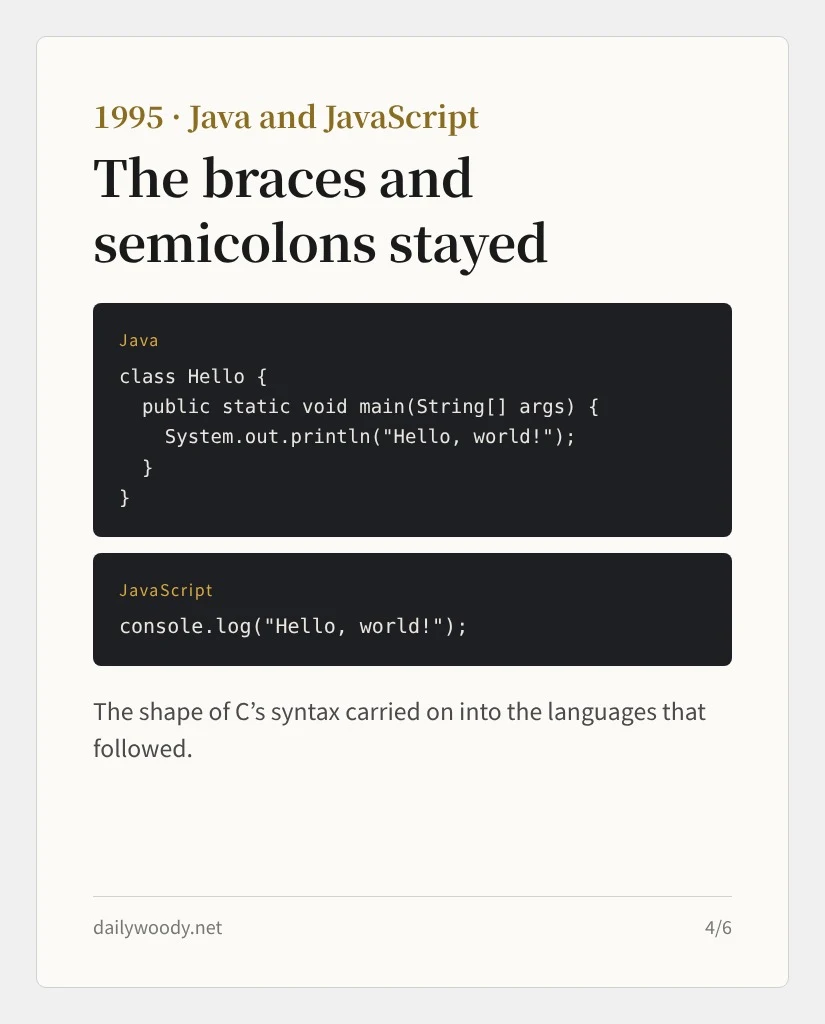
The family tree of hello, world, in six cards.Swipe to see more →



Sources
- Source ↗ Brian W. Kernighan, "Dennis M. Ritchie (1941-2011)," National Academy of Engineering, Memorial Tributes, Vol. 20 (2016)
- Source ↗ The Associated Press, "Dennis Ritchie, co-creator of Unix software, dies," via CBC, Oct. 13, 2011
- Steve Lohr, "Dennis Ritchie, Trailblazer in Digital Era, Dies at 70," The New York Times, Oct. 13, 2011
- Martin Campbell-Kelly, "Dennis Ritchie obituary," The Guardian, Oct. 13, 2011
- "Dennis Ritchie and John McCarthy: machine whisperers," The Economist, print edition, Nov. 5, 2011
- "Dennis Ritchie: The Shoulders Steve Jobs Stood On," Wired, October 2011
- Rob Pike, Google+ post, Oct. 12, 2011 (service closed; quoted in contemporary reports)
- The Washington Post, October 2011 (Paul Ceruzzi's remarks, as quoted by NBC News)





댓글
댓글 쓰기