Game of the Century at 70: Fischer, 13, Tied for Eighth
Woody Magazine
We write the things that aren't news
Oct. 16, 2026 (Fri.)
The Game of the Century at 70: Fischer, 13, Finished Tied for Eighth
The queen sacrifice everyone remembers got its name weeks later, on a magazine cover
In Three Lines
- On Oct. 17, 1956, a 13-year-old Bobby Fischer gave up his queen and beat one of America's best players.
- He finished that tournament tied for eighth of 12, and the first printed report gave the game no name at all.
- The game was not overrated. The phrase "Game of the Century" came with a qualifier attached: among chess prodigies.
Tomorrow marks 70 years since the chess game known as the Game of the Century. Even casual chess fans know the name. In New York in 1956, Bobby Fischer, then 13, gave up his queen against Donald Byrne, 26, and won. Fischer went on to become world champion, and the story of his rise usually starts here. The name sounds like a verdict on a hundred years of chess, and it is natural to hear it that way. But it came with small type.
Picture a diner with a sign out front that says "Best Burger in Town." At the bottom of the menu, in small type, it adds: "in this price range." Most customers remember the sign. The Game of the Century traveled the same way, and to find the small type you have to go back to the fall of 1956.
A boy's first tournament among adults
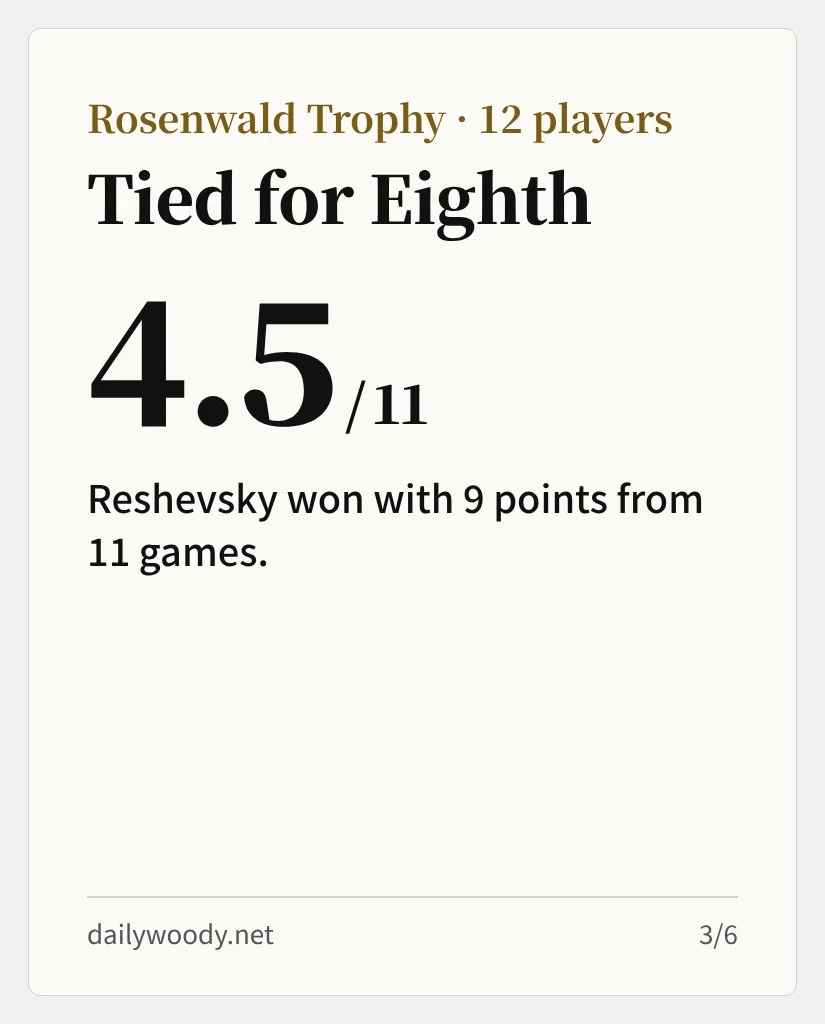
The event was the Rosenwald Trophy, an invitational funded by the philanthropist Lessing J. Rosenwald and a forerunner of the U.S. Championship. The October 1956 edition was the third. Twelve players took part, each meeting every other once.
Fischer was there because he had won the U.S. Junior Championship that July. It was the first time he faced a field made up entirely of adults. He lost in the first round to the reigning U.S. champion, Arthur Bisguier, and in the second to Abe Turner. Losing twice in a row to masters is about what you would expect from a 13-year-old.
Oct. 17: The move that left the queen hanging
Byrne had won the U.S. Open in 1953 and ranked among the country's leading players. In the first round of this same tournament he had beaten Samuel Reshevsky, America's top grandmaster. He had White; Fischer had Black.
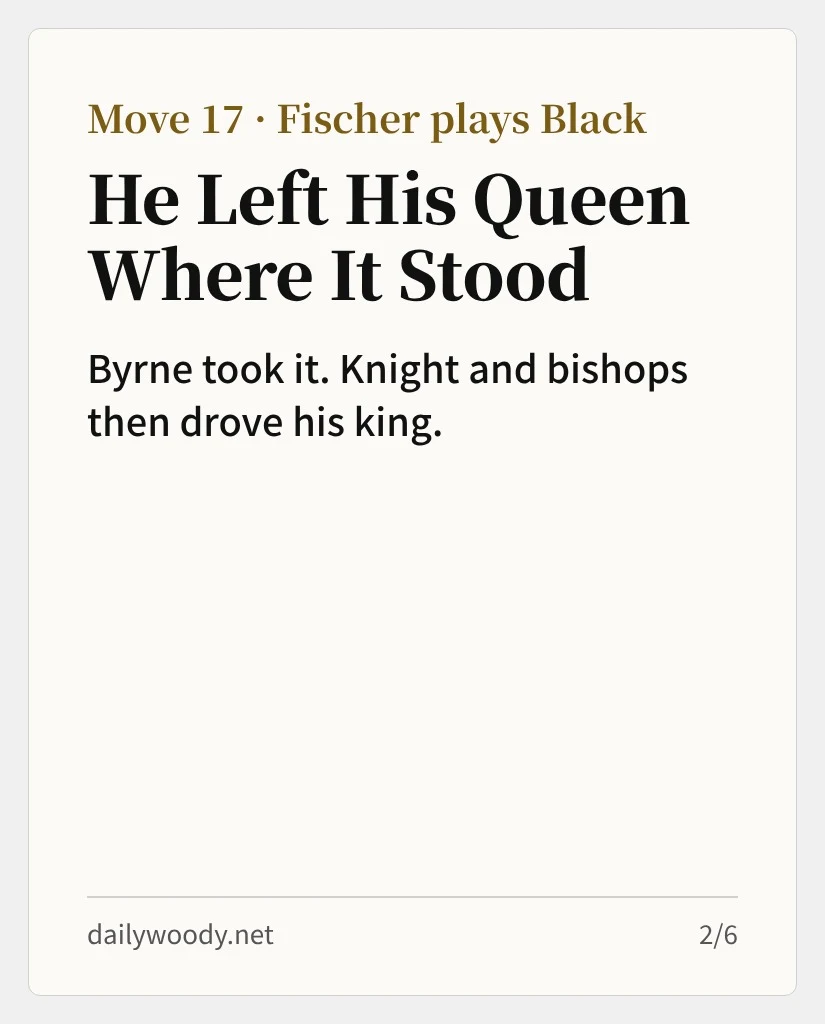
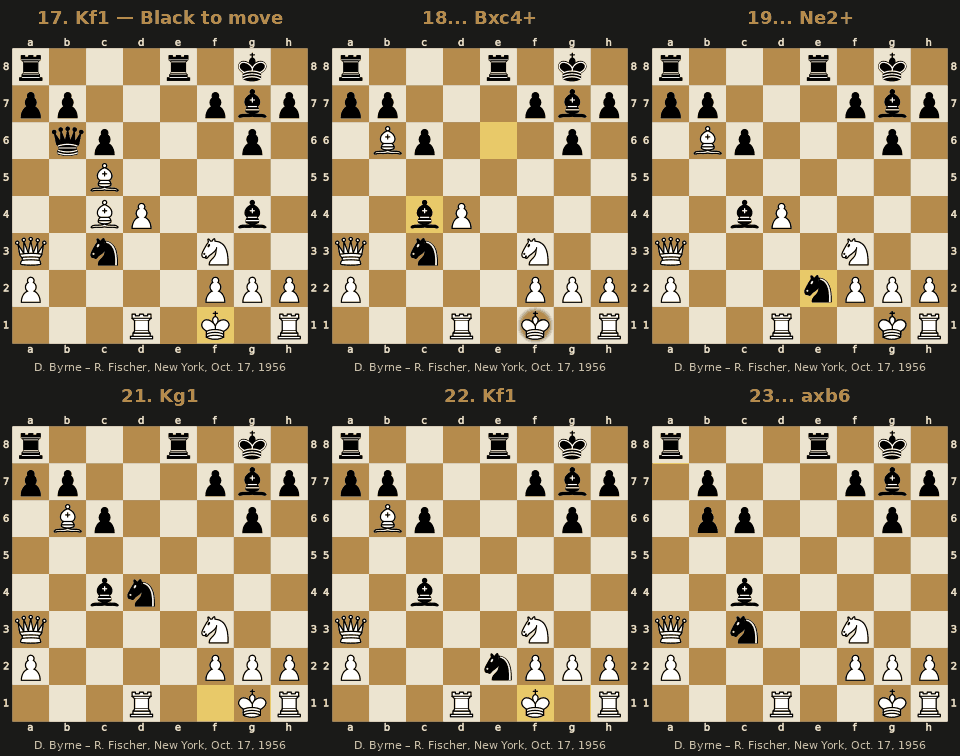
On move 11, Fischer offered Byrne a knight. Byrne declined, the position grew sharper, and on move 16 a White bishop attacked Fischer's queen. The usual response is to move the queen. Fischer left it where it was and played 17...Be6 instead. Byrne took the queen. What followed was a run of checks from Fischer's knight and bishops that chased the White king into a corner. Within a few moves, Black had collected a rook, both of White's bishops and a pawn.

The chess writer Hans Kmoch was in the room. He noted that Fischer had used up a lot of time in the opening, then played the decisive sequence in about 20 minutes.
Most masters resign once a game is clearly lost. Byrne did not. According to his former student Dan Heisman, Byrne asked the other players whether it would be a fair tribute to let the boy finish the job. They agreed, and Byrne played on until Fischer mated him on move 41.
The tournament belonged to Reshevsky
The Nov. 5 issue of Chess Life, the U.S. Chess Federation's newspaper, led with the winner. Reshevsky scored 9 points from 11 games, and his only loss was that first-round game against Byrne. Bisguier was second.
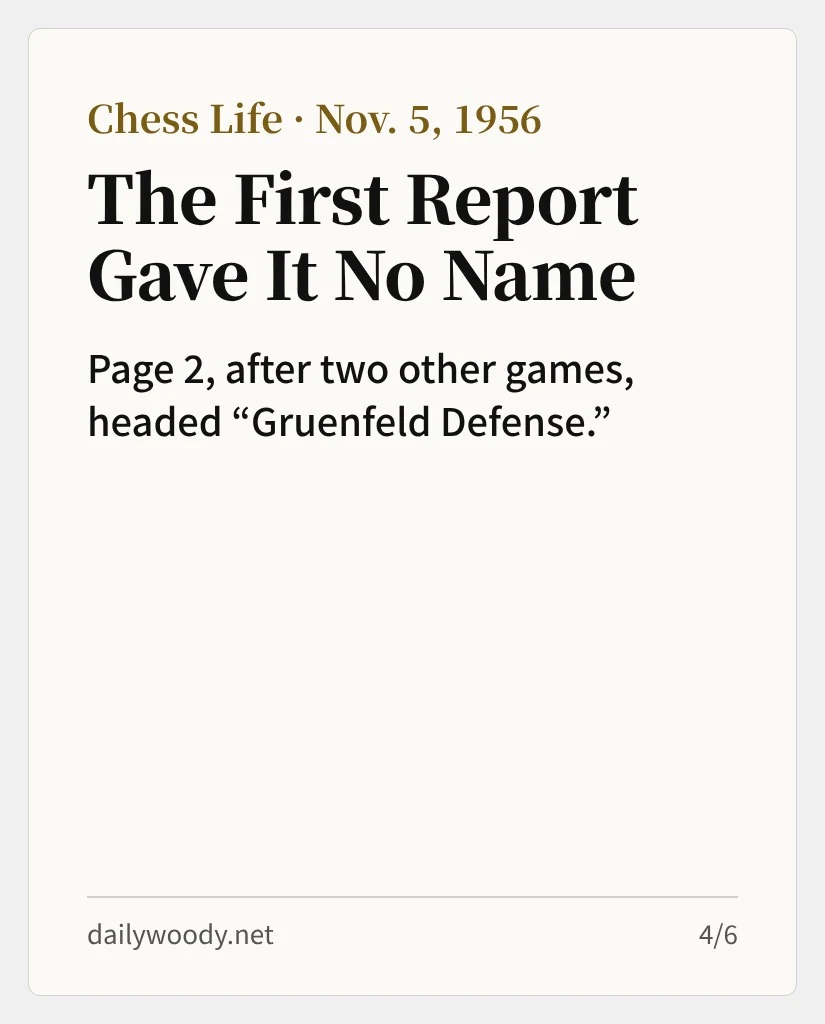
The Byrne-Fischer game ran on Page 2, after two other games, under the plain heading "Gruenfeld Defense." The paper's New York column gave it one line, calling it a "fantastic winning Queen sacrifice," and noted that the tournament had been well run by Kmoch. Kmoch, in other words, was not just a spectator. He was the tournament director.
A fair objection: the game was still brilliant, wasn't it? It was. Two weeks later, Chess Life reported that it had won the tournament's brilliancy prize as the most meritorious game of the event. That was the scale at the time. The word "century" came from somewhere else.
A month later, a name on a cover
The name came from Kmoch. He was a Vienna-born international master who managed the Manhattan Chess Club and directed its tournaments. He also wrote for Chess Review, then the leading chess magazine in the United States. Its December 1956 cover carried a photo of Fischer, reportedly taken during the game, beside the words "Game of the Century."
Inside, Kmoch's introduction to the game carries the small type. He called the game a masterpiece of combination by a 13-year-old against a formidable opponent, one that "matches the finest on record in the history of chess prodigies." He then set it beside games played by Paul Morphy, the 19th-century American prodigy, at 13; by Reshevsky at 11; and by José Raúl Capablanca, the Cuban world champion, at 12. The sign said Game of the Century. The menu said among prodigies.
The cover even got the page number wrong, and one Australian critic wrote about an entirely different game, believing it was the one the magazine had called the Game of the Century. The name spread; the qualifier fell away. The chess historian Edward Winter has pointed out that some later writers quoted the phrase without mentioning that it was made in the context of prodigies.
Fischer left it out of his own best-games book
The rest is the Fischer we know. He won the U.S. Championship at 14, became the world's youngest grandmaster in 1958 at 15, and took the world title in 1972. Few remember the tied-for-eighth finish.
Fischer's own view is harder to read. He included the game in a slim 1959 collection. But "My 60 Memorable Games," the annotated book he published in 1969, does not contain it, a gap a British reviewer pointed out at the time. No explanation from Fischer is on record. Even so, a sales description for a later reissue says the book includes the Game of the Century, "played when he was only 15." The game is not in the book, and Fischer was 13.
The game has been admired as a masterpiece for 70 years. What changed was the size of its name. At the tournament it was a score under "Gruenfeld Defense." In the magazine it was among the finest by any prodigy. After that it was simply the Game of the Century. The small type was on the menu from the start. We just walked out remembering the sign.
At a Glance
This story in six cards.Swipe to see more →



Sources
- Source ↗ Chess Life, Nov. 5, 1956 (US Chess archive)
- Source ↗ US Chess, "Throwback Thursday: Game of the Century Goes Viral in November 1956" (2020)
- Source ↗ Edward Winter, "The Byrne v Fischer 'Game of the Century'," Chess Notes
- Hans Kmoch, "The Third Rosenwald Tournament: Game of the Century," Chess Review, December 1956
- Source ↗ ChessBase, "Remembering Donald Byrne"
- Source ↗ Dan Heisman, "A Talk to Remember Coach Donald Byrne," Chess.com
- Source ↗ Book Outlet, "My 60 Memorable Games" (Batsford, 2009) product page
- Source ↗ ChessBase, "The game that shook the world" (2020)
- Source ↗ ChessBase, "60 years ago: 14-year old Bobby Fischer wins US Championship" (2018)
- Source ↗ Chessgames.com, Hans Kmoch player page

댓글
댓글 쓰기