Statue of Liberty at 140: It Started Out as a Lighthouse
Woody Magazine
We write the things that aren't news
Oct. 27, 2026 (Tue.)
Statue of Liberty at 140: It Started Out as a Lighthouse
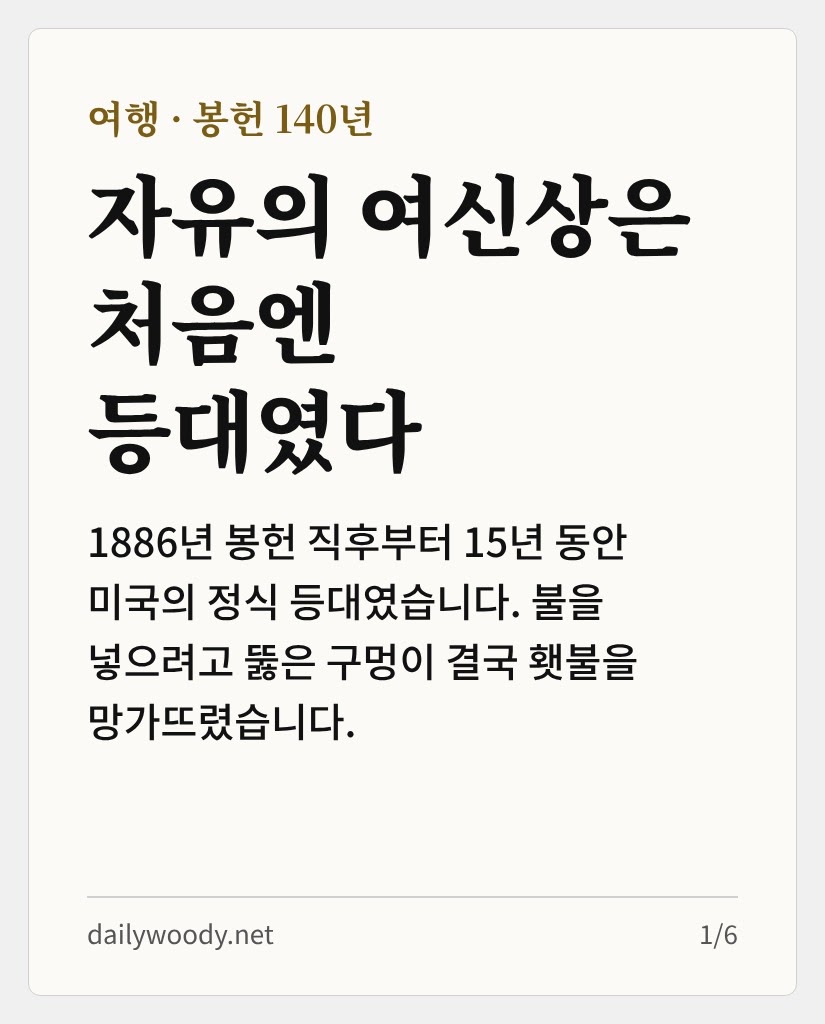
The torch was never built to give off light. The government cut holes in it to put lamps inside, and those holes spent a century wearing it down.
At a Glance
This story in six cards.Swipe to see more →



Tomorrow, Oct. 28, marks 140 years since the Statue of Liberty was dedicated in New York Harbor. At night she stands over the dark water, holding up a gold torch that seems to burn.
It's natural to see that torch as a lamp. Even the statue's formal name is "Liberty Enlightening the World."
Yet there is no lamp inside it. Floodlights aim at a copper flame covered in gold leaf, and the flame throws their light back. That is close to what the sculptor, Frédéric Auguste Bartholdi, had in mind. In his 1874 conception, the flame was solid copper sheet, gilded to catch the sun by day. It was never meant to be lit from within.
The U.S. government lit it anyway. A lamp sealed inside copper sends no light anywhere, so the government cut holes in the flame. It ran the statue as a lighthouse for 15 years, and after that it opened the flame up even further. In the end, those openings ruined the torch.
November 1886: Two Rows of Holes in the Flame
The statue was a gift from the people of France for the centennial of American independence. When President Grover Cleveland dedicated it on Oct. 28, 1886, unveiling it to the public, the torch was dark. The country's lighthouses and buoys were then run by the U.S. Lighthouse Board, an agency of the Treasury Department. In its 1892 annual report, the board recalled the problem. Once the statue was up, there was no way to show a light except, possibly, through the small windows in the crown.
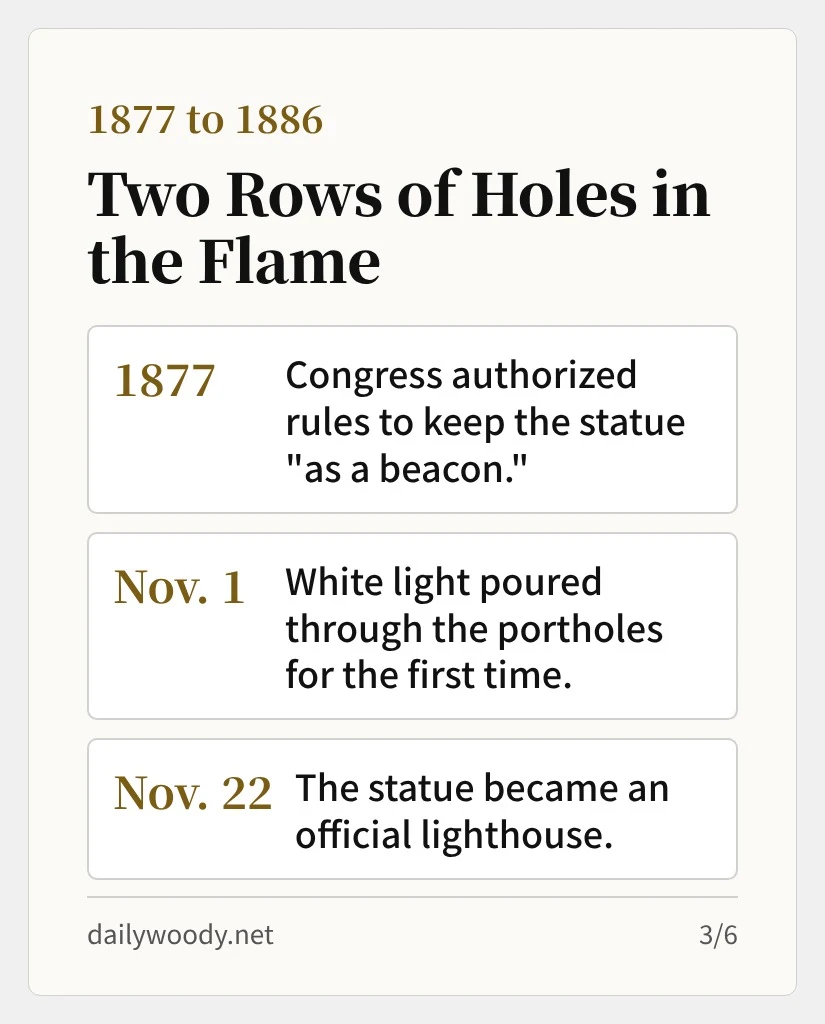
A light was required anyway, because the law already said so. When Congress accepted France's gift on March 3, 1877, nine years before the dedication, it authorized the president to make rules for maintaining the statue "as a beacon." The board pointed to the name as well.
"The very name of the statue almost imperatively demanded that it should exhibit a light." — Annual Report of the Lighthouse Board, 1892
That left the question of how. Just below the flame, a small balcony rings the torch. One proposal put lamps on that balcony to shine back onto the flame, but the report noted that those lamps would sit exposed to every kind of weather. In lighting the flame from outside, it was essentially how the torch is lit today.
Lt. John Millis of the Army Corps of Engineers went the other way. He would put electric lamps inside the flame and cut two rows of round windows, like a ship's portholes, into the copper. His plan was approved. As a result, the light inside could be seen only as far as it leaked out through those holes.
Rain on dedication day pushed the fireworks back. On Nov. 1, at about 7:30 p.m., with fireworks going off, white light poured from the torch for the first time. People had hoped it would carry 50 miles out to sea. It soon became clear it wouldn't, and the National Park Service later wrote that the lighting problem "was long a perplexing one."
Dim as it was, the designation went ahead. On Nov. 16, citing the 1877 resolution, Cleveland ordered the Lighthouse Board to maintain the statue as a beacon. On Nov. 22 it went into service as an official lighthouse.
Fifteen Years Under the Lighthouse Board
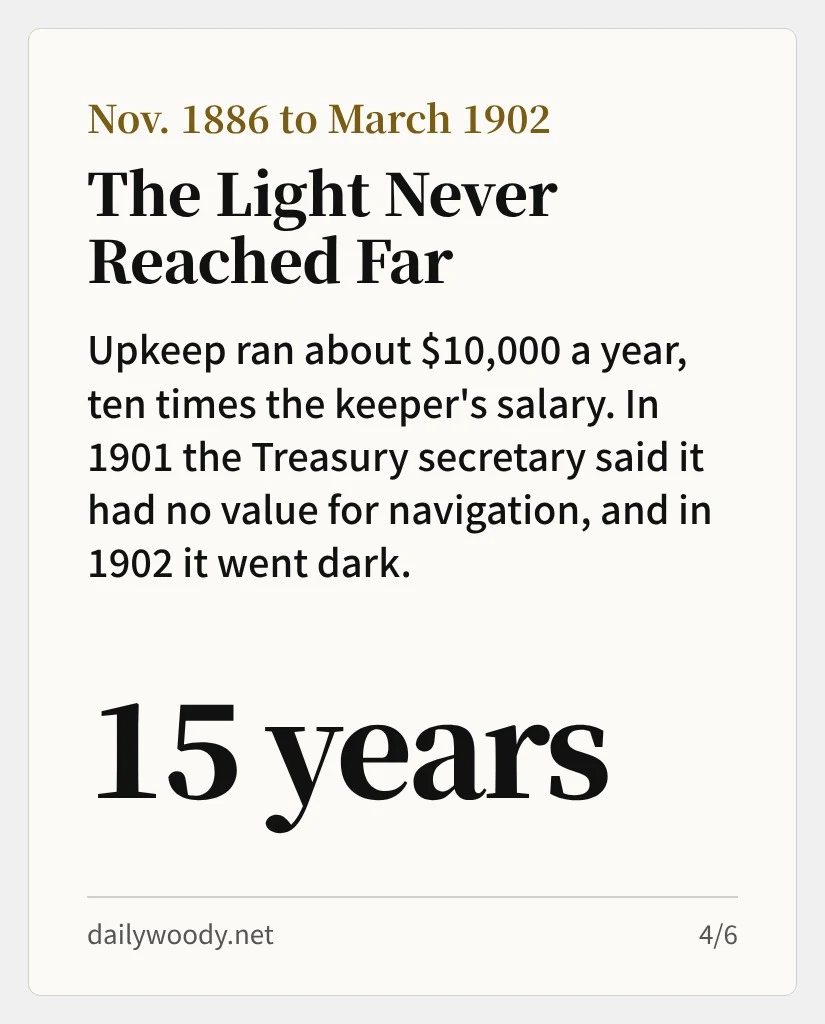
The board had not asked for the job, and its reluctance made sense. A lighthouse exists to throw a strong, clear light far enough for ships to fix their position at night. The board never considered this light important to navigation. In the Park Service's own summary, the statue was not designed as a lighthouse and was not very effective as one.
Think of a trophy with holes drilled in it so it can double as a desk lamp. A trophy is made to be looked at. A bulb inside it won't light the room.
The room stayed dim, but the bills kept coming. Even the keeper was unusual. Albert Littlefield, who already knew the electrical plant, was formally appointed head keeper in late 1886. He earned $1,000 a year, at a time when most head keepers made $250 to $600. Upkeep ran about ten times his salary, roughly $10,000 a year, and came out of the lighthouse budget. The board asked Congress for special funds and got none.
The board kept trying. In October 1892 it replaced the portholes with a continuous horizontal band of plate glass. It also set a skylight of colored glass in the top of the flame, so the light would look more like real fire.
None of it changed the assessment. In 1901 Treasury Secretary Lyman Gage said the statue had no value as a navigational light and was a financial burden on his department. He recommended handing it to the War Department, which had its own reason to take it: the island held a star-shaped Army fort, and the statue's pedestal stood inside its walls. Coast Guard records say the light was deemed "useless." President Theodore Roosevelt approved the transfer on Dec. 30, 1901, and on March 1, 1902, the lighthouse went dark. Littlefield had been its first and only head keeper.
The Lighthouse Bartholdi Wanted to Build in Egypt
A fair objection: wasn't Bartholdi himself trying to build a lighthouse? He was.
In 1867 he first pitched his idea to Isma'il Pasha, the viceroy who ruled Egypt, while he was visiting the Paris Universal Exposition. Bartholdi proposed a colossal statue at the entrance to the Suez Canal, then under construction. It would show an Egyptian peasant woman holding a torch aloft, and it would double as a lighthouse. He kept lobbying through the canal's opening in 1869, but the viceroy turned it down as too costly. At Port Said, the canal's Mediterranean gateway, a lighthouse by another designer was finished in time for the opening.
In 1986, Aramco World, the cultural magazine published by the Saudi oil company, traced Liberty back to that Suez project. By its account, though, the beacon in both the Suez design and the early plans for Liberty was meant to shine from the figure's head. The torch was symbolic. That fits the Lighthouse Board's finding that the statue arrived with no place for a light except the crown. Even in the lighthouse Bartholdi dreamed of, the torch was something to hold up, not something to see by.
1916: The Holes Become Windows
The lighthouse job ended in 1902. The effort to make the torch glow did not. Even after its time as a lighthouse, the torch was lit again, and it was burning in the summer of 1916.
Around 2 a.m. on July 30, 1916, an explosion tore through a munitions depot on Black Tom Island, across the water in Jersey City. It was World War I, and the depot held ammunition bound for the Allies. German saboteurs had set it on fire. The shock wave pushed the torch arm against the crown and damaged the frame inside. According to the National Park Service, the torch stayed lit through it all.
Until then, some visitors, with permission, had climbed a ladder inside the arm to the torch. After the explosion, that climb never reopened to visitors.
On the evening of Dec. 2 that year, President Woodrow Wilson sent a wireless signal from the presidential yacht Mayflower and switched on a new lighting system. Its 246 floodlights, set in the points of the star-shaped fort and on rooftops around the island, lit the whole statue. Wanting the statue to shine was reasonable enough. Its name promised as much.
As part of the same project, the sculptor Gutzon Borglum rebuilt the flame. Years later he would carve Mount Rushmore. To let the light inside show through, he cut away much of the copper and fitted hundreds of pieces of yellow glass in its place. In trophy terms, he cut a window in it. That glass flame is the torch Americans saw in photographs until 1984.
The cost arrived slowly. Rain and snow seeped in through the seams around the glass, and over the decades the copper and the frame beneath it corroded. The National Park Service traces the damage to that redesign: Borglum "put all the holes in it with amber glass," as the park's superintendent put it. When a major restoration began ahead of the statue's 1986 centennial, experts who examined the torch found it beyond repair above the handle.
1984: Back to the Original Design
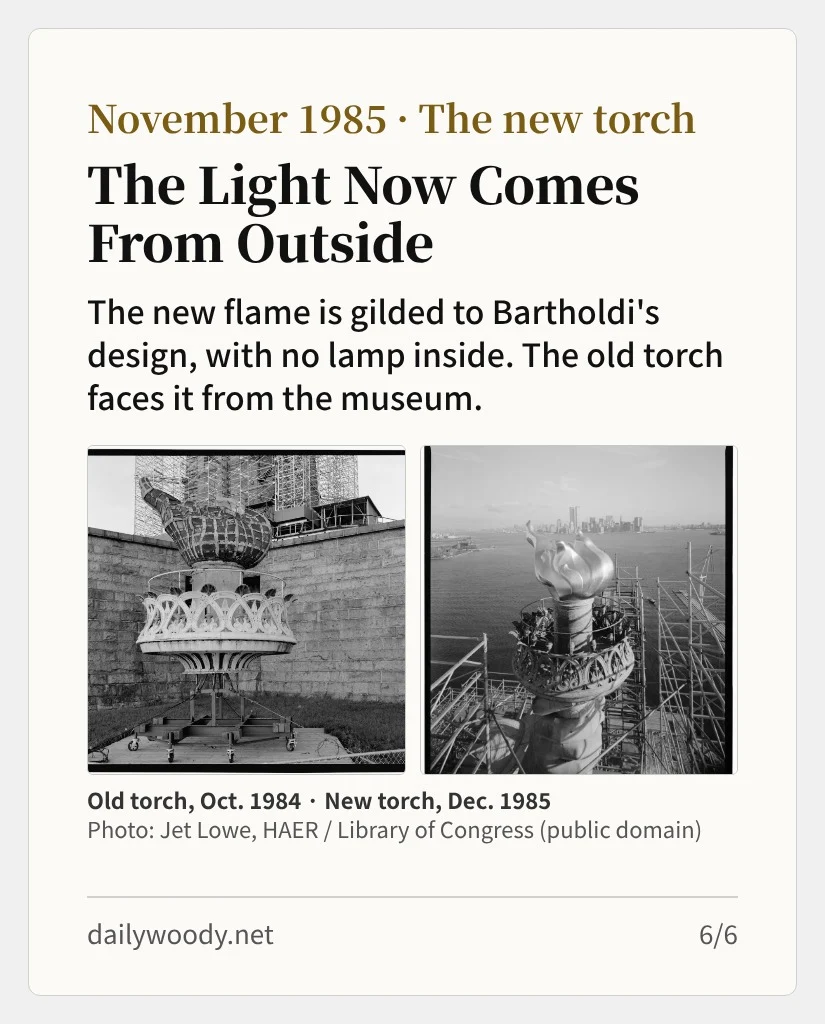
On July 4, 1984, workers lowered the old torch by crane. It had already been cut free at the handle. A new one went up in its place in November 1985. The new flame has no holes and no glass. It follows Bartholdi's design, hammered from copper sheet and gilded as he had planned. Nothing glows inside it. Floodlights shine on the gold, the outside approach that lost out to the weather in 1886.
On the night of July 3, 1986, President Ronald Reagan pressed a button on Governors Island that sent a laser beam across the harbor and lit up the restored torch. A century earlier, a president had ordered a light placed inside the flame. This time the president's light shone on it from outside.
The old torch, glass and all, now stands in the Statue of Liberty Museum on Liberty Island. It is 16 feet tall and weighs 3,600 pounds. The museum opened in 2019, and admission comes with the ferry ticket. Through the gallery's glass walls, the old torch faces the gold one that replaced it, so visitors can see both at once.
"Liberty Enlightening the World" was a metaphor. The government read it as an engineering spec and cut holes in the flame to put lamps inside. The lighthouse lasted 15 years. The holes wore at the torch for nearly a century. The restorers built a new flame with no holes in it. The trophy went back on the shelf, and the light now comes from outside.
Sources
- Source ↗ Statue of Liberty-Ellis Island Foundation, Overview + History
- Source ↗ National Park Service, Historical Handbook: Statue of Liberty, "Improvements in the Statue Since 1886"
- Source ↗ National Park Service, An Administrative History of the Statue of Liberty National Monument
- Source ↗ National Park Service, Statue of Liberty National Monument (Park History)
- Source ↗ National Park Service, Restoring the Statue
- Source ↗ National Park Service, Domestic Sabotage: The Explosion at Black Tom Island
- Source ↗ U.S. Coast Guard Historian's Office, Statue of Liberty Light
- Source ↗ Lighthouse Friends, Statue of Liberty Lighthouse (includes the Lighthouse Board's 1892 annual report)
- Source ↗ Aramco World, "The New Colossus," September/October 1986
- Source ↗ Record and Guide, Dec. 9, 1916 (Columbia University Libraries)
- Source ↗ New Jersey Department of Environmental Protection, Black Tom centennial release (2016)
- Source ↗ Ronald Reagan Presidential Library, Proclamation on Let Freedom Ring Day, July 2, 1986
- Source ↗ The Christian Science Monitor, "Miss Liberty's torch," Nov. 29, 1985
- Source ↗ The Associated Press, "Statue of Liberty's original torch moved to museum site," 2018
- Source ↗ The American Presidency Project, Grover Cleveland, Executive Order, Nov. 16, 1886
- Source ↗ National Park Service, "Changing Landscapes, 1886–1954"
- Source ↗ Lighthouse Digest, "Keeping Liberty's Light"
- Source ↗ U.S. Lighthouse Society, Lighthouse Facts
- Source ↗ WABC-TV, "New museum celebrating the history of the Statue of Liberty opens," May 16, 2019
- "Liberty's Light," wire report dated Nov. 1, 1886

댓글
댓글 쓰기