"Lost Generation" at 100: It Began as a French Boss's Gripe
Woody Magazine
We write the things that aren't news
Oct. 21, 2026 (Wed.)
"Lost Generation" Turns 100 Tomorrow — It Began as a French Boss's Gripe
Hemingway put it on the first page of his first novel. As he told it, a garage owner said it first, and "perdue" meant "no good," not "adrift."
At a Glance
This story in six cards.Swipe to see more →


One hundred years ago tomorrow, on Oct. 22, 1926, Charles Scribner's Sons published Ernest Hemingway's first novel, The Sun Also Rises. Before the story begins, two epigraphs face the reader. One reads, "You are all a lost generation," credited only to "Gertrude Stein in conversation." The other is a passage from Ecclesiastes.
Hemingway later wrote that he had tried to balance one against the other. Picture a scale with Stein on one pan and Ecclesiastes on the other. A century on, we remember only one pan: Stein's. Her line became the name for the young people who came of age in World War I.
Most of us credit the phrase to Stein, and with reason. She was the American writer whose Paris salon drew Picasso and a stream of young expatriates, and she did say it to Hemingway. Most reference books credit her as well. Even the dictionary of the Académie française lists "génération perdue" as her coinage. But Stein heard it from someone else, and in French. And on its way into an English-language novel, the phrase came to mean something else to its readers.
A Garage in the Ain
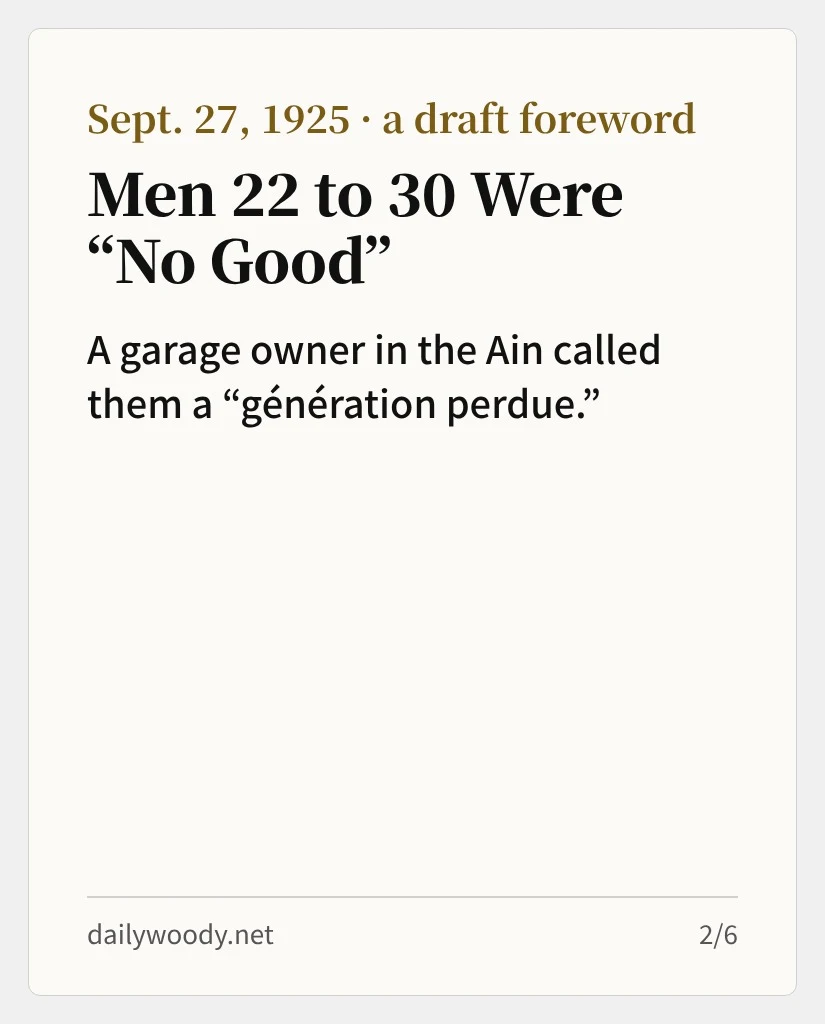
On Sept. 27, 1925, while he was drafting the novel, Hemingway wrote a foreword in his notebook. The book's working title at the time was The Lost Generation. The draft opens with Stein stopping at a garage in a small town in the Ain, in eastern France, to have a valve fixed on her Ford.
In that telling, the owner said the young mechanics he had taken on and trained himself were fine. It was the ones between 22 and 30 who were no good. They were a lost generation, he said, and nobody wanted them. His words were "génération perdue."
Hemingway, born in 1899, was in that bracket himself. The draft goes on to suggest that the war had already shaped his generation for good.
The Foreword Stayed in the Notebook
Hemingway never printed the foreword, and he dropped the working title. The notebook's cover carried his first idea for a title, Fiesta, which later went on the British edition. The American edition took its name from Ecclesiastes.
What reached readers in 1926 was one sentence and the words "in conversation." The garage, the Ain and the owner's complaint about men of 22 to 30 were gone. Readers knew only that Stein had said it to someone. The draft page was reproduced decades later, in a 1983 book by the Hemingway scholar Frederic Svoboda.
Stein Remembered a Hotel Keeper
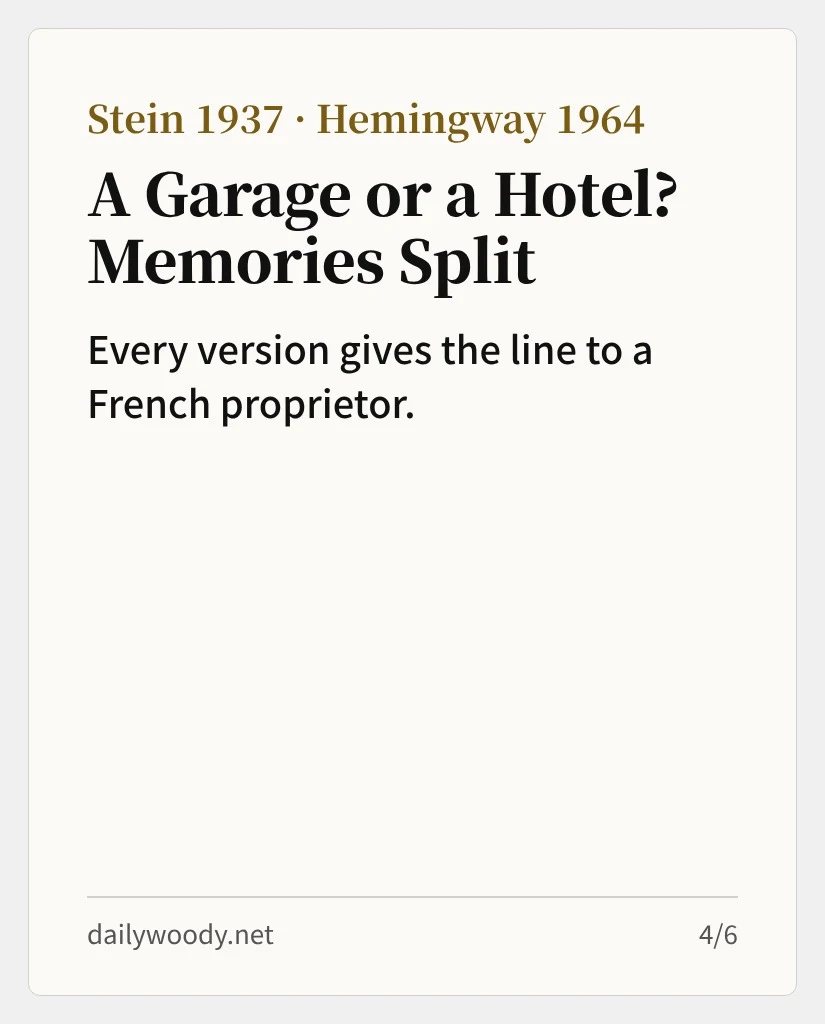
Two people telling the same story ought to agree on the scene. They did not. In Everybody's Autobiography (1937), Stein gave the line to a hotel keeper in Belley, also in the Ain. A man becomes civilized between 18 and 25, he told her, and the ones who went to war missed those years.
Hemingway's memoir A Moveable Feast, published in 1964, three years after his death, moves the scene back to a garage. Stein's old Model T had ignition trouble. A young mechanic who had served in the last year of the war failed to fix it. After Stein complained, the patron scolded him: You are all a génération perdue.
The settings differ, and so do the targets: one mechanic, men between 22 and 30, the generation that went to war. What the versions share is a French proprietor shaking his head over men young enough to have fought. None of them says anyone had lost his way.
"Perdu" Can Mean "Wasted"
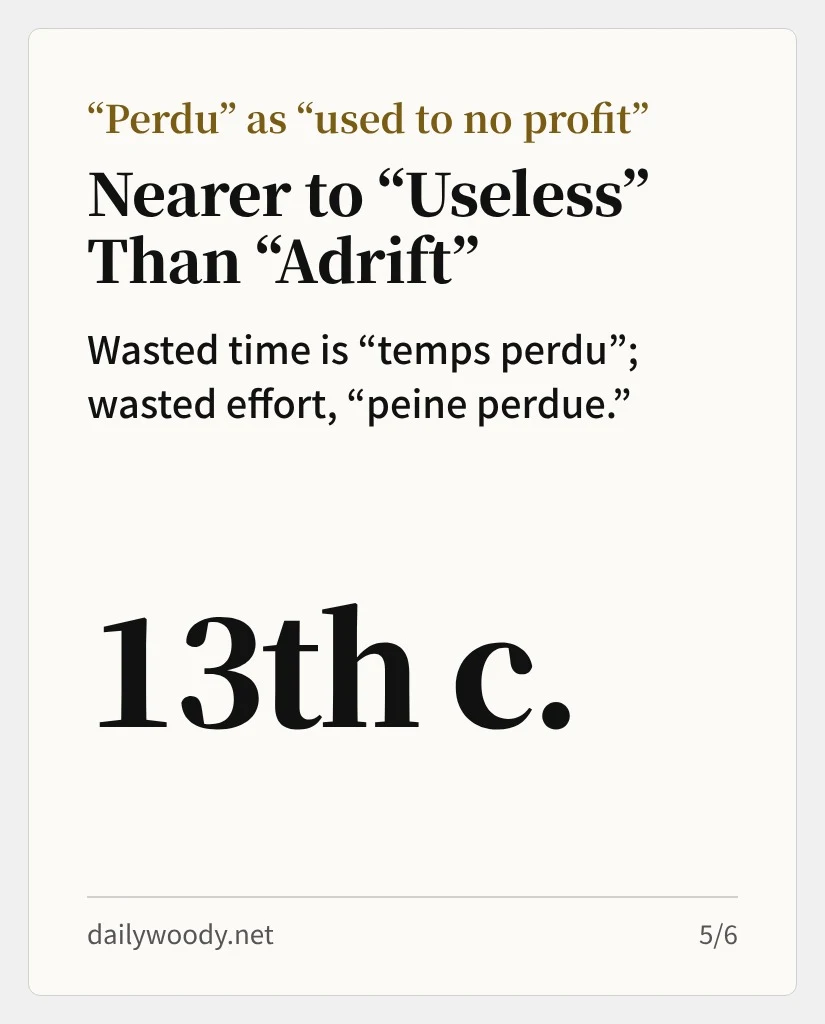
"Perdu" usually comes into English as "lost," but the French word covers more ground. The Académie française dictionary traces its sense of "used to no profit" to the 13th century. Its examples show the range. Wasted time is "temps perdu," wasted effort is "peine perdue," and a patient who is "perdu" is beyond saving.
When a garage owner says it of a slow mechanic, the phrase sits nearer to "useless" than to "adrift." The young man had gone to war and come back, in his boss's eyes, good for nothing.
English "Lost" Carried Both Meanings
English "lost" holds both meanings too. The Online Etymology Dictionary dates its sense of "wasted, ruined, spent in vain" to about 1500, and "no longer to be found, gone astray" to the 1520s. The two settled into the word within a generation of each other. The same dictionary records Hemingway's novel as the first known use of "Lost Generation."
Readers, though, never saw the garage. They had Stein's name and the word "lost," and they heard the later sense. Britannica explains that the generation was lost because its inherited values no longer fit the postwar world. That is a question of direction, not of usefulness.
Either reading is unkind, a reader might object. True. But one is a verdict on a worker's skill, and the other is a diagnosis of a state of mind. The garage meant the first. The book's readers heard the second.
This was not wordplay on Hemingway's part. No record shows that he meant both senses. The book simply left out the garage that would have fixed the meaning.
Ecclesiastes on the Other Pan
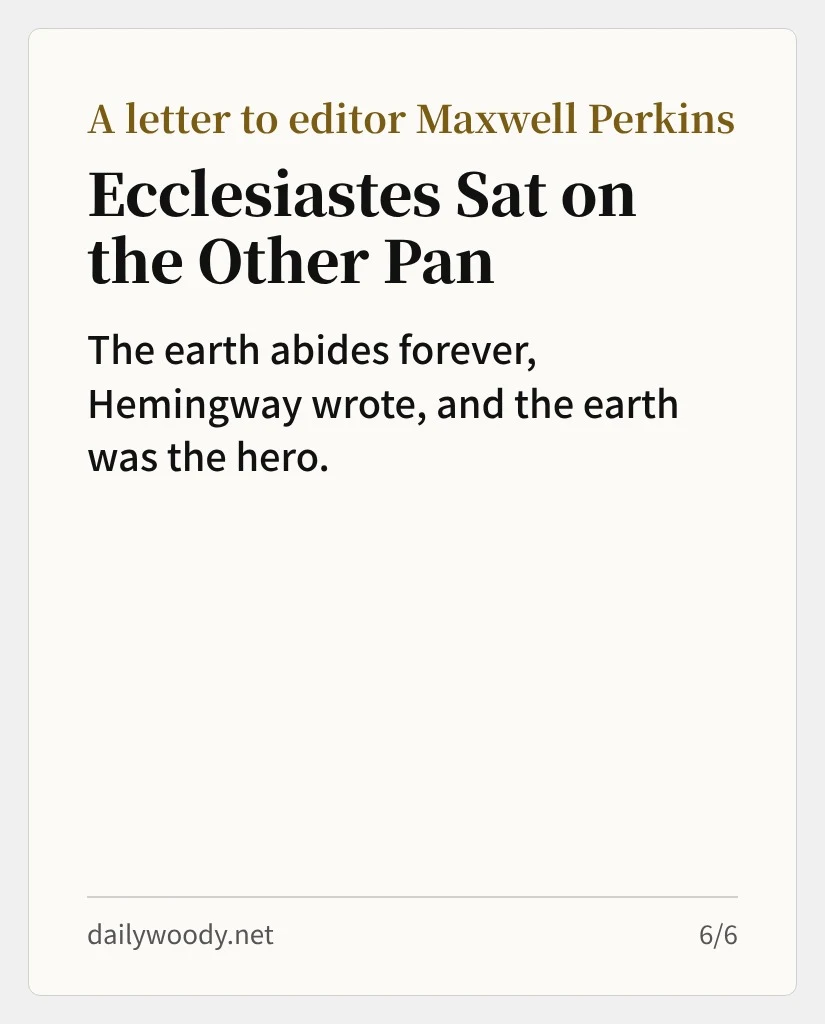
The novel's characters drink their way from Paris to the bullfights in Pamplona, so the book is easy to read as a portrait of drift. Hemingway told his editor at Scribner's, Maxwell Perkins, something else. The point of the book, he wrote, was that the earth abides forever, and the earth was its hero. He had great fondness for the earth, he added, and not much for his generation.
One generation passeth away, and another generation cometh: but the earth abideth for ever. — Ecclesiastes 1:4
The same impatience runs through A Moveable Feast. Walking home the night Stein lectured him, Hemingway decided that every generation had been lost by something and always would be. He resolved to be done with her lost-generation talk and every easy label. It is the conclusion of a man who took his title from Ecclesiastes.
A garage owner was talking about his own workers. Between the shop and the printed page the garage dropped out, and without it the phrase was read another way. Hemingway set Ecclesiastes opposite Stein's line. A hundred years later, we remember only one side.
Sources
- Source ↗ John F. Kennedy Presidential Library, "Hemingway's Works (By First Publication)"
- Source ↗ U.S. National Archives, press release on the Hemingway centennial exhibit (1999)
- Source ↗ Quote Investigator, "You Are All a Lost Generation" (Sept. 24, 2022)
- Source ↗ Dictionnaire de l'Académie française, 9th ed., "perdu, -ue"
- Source ↗ Online Etymology Dictionary, "lost"
- Source ↗ Encyclopaedia Britannica, "Lost Generation"
- Ernest Hemingway, A Moveable Feast (1964), chapter "Une Génération Perdue"
- Gertrude Stein, Everybody's Autobiography (1937)
- Frederic Joseph Svoboda, Hemingway & The Sun Also Rises: The Crafting of a Style (University Press of Kansas, 1983)
- Rena Sanderson, Sandra Spanier and Robert W. Trogdon, eds., The Letters of Ernest Hemingway, Vol. 3 (1926–1929), Cambridge University Press





댓글
댓글 쓰기