The Louvre Heist, a Year On: €83M for Security, €3M Spent
Woody Magazine
We write the things that aren't news
Oct. 19, 2026 (Mon.)
A Year After the Louvre Heist: €83 Million for Security, €3 Million Spent
The balcony the thieves climbed had been flagged in a security report seven years earlier.
At a Glance
This story in six cards.Swipe to see more →
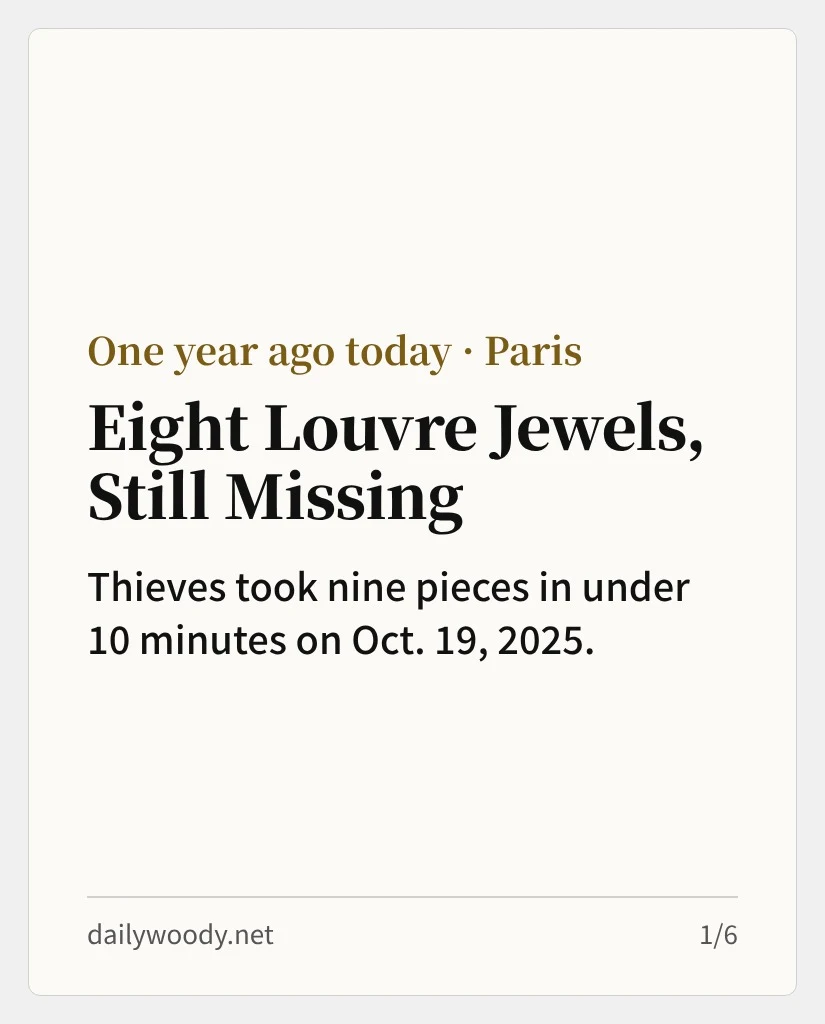


One year ago today, on the morning of Sunday, Oct. 19, 2025, a moving truck with an extendable ladder pulled up against the Seine side of the Louvre in Paris. Men in high-visibility vests used it to reach a balcony, then cut through a window with power tools. Behind the glass was the Apollo Gallery, where France displayed its crown jewels.
The gallery is a 200-foot hall decorated for Louis XIV. Versailles later modeled its Hall of Mirrors on it.
The men smashed two display cases, took nine pieces and fled on motorbikes in less than 10 minutes. On the way out they dropped one: the crown of Empress Eugénie, wife of Napoleon III. The other eight, valued at €88 million, or about $102 million at the time, have never been found.
At first the theft played like a movie caper. Within weeks it had turned into a story about a careless museum. Only one of the two cameras near the break-in point was working. The security control room did not have enough screens to show every camera at once. Noël Corbin, who led the culture ministry’s inquiry, told French senators that 30 seconds might have been enough for guards or police to stop the thieves.
The obvious conclusion is that the world’s most famous museum skimped on security and paid for it. The documents released over the past year tell a less comfortable story. The Louvre had the warning. It also had the money.
The balcony was in a 2018 report
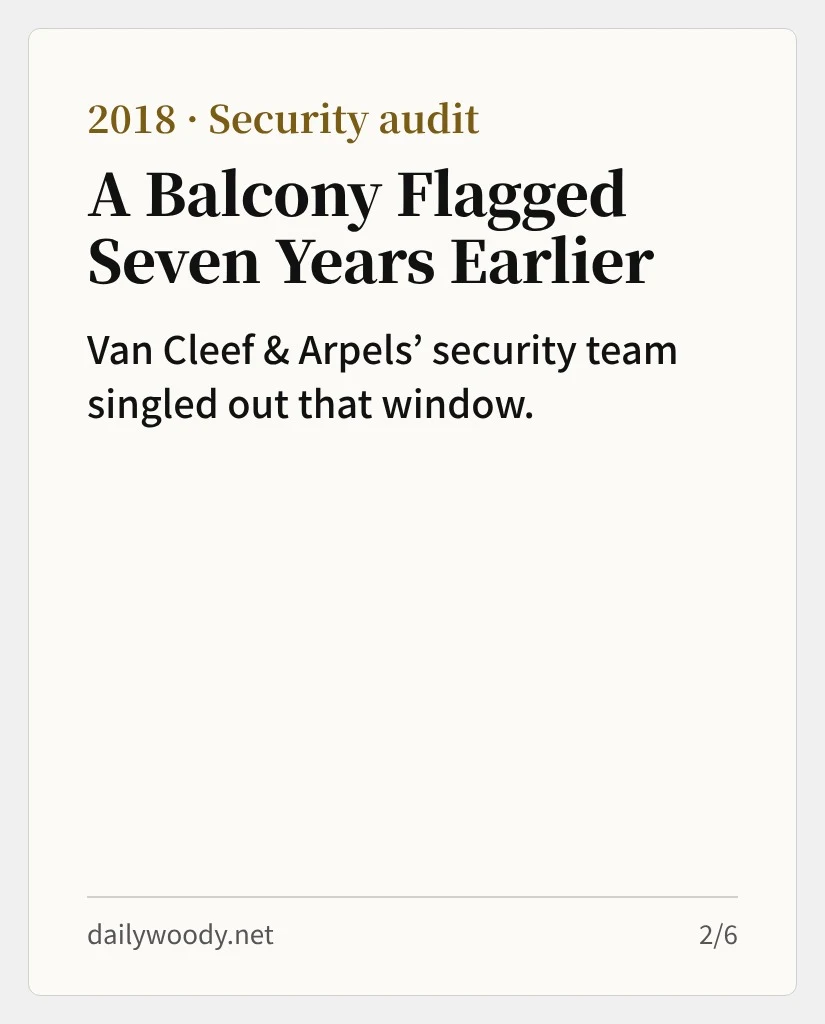
In 2018, Jean-Luc Martinez, then the Louvre’s director, brought in outsiders to audit the museum’s security. He chose the security department of Van Cleef & Arpels, a jeweler whose business depends on keeping gems out of thieves’ hands.
The audit gave two pages and three diagrams to the Apollo Gallery balcony alone. It named the Seine-side window as one of the museum’s weakest points and noted that a freight lift could reach it. Seven years later, that is exactly how the thieves got in.
According to the Louvre, the outgoing leadership never passed the report on. Laurence des Cars, who took over in September 2021, first saw it after the theft. It turned up only when she had staff pull every document on the gallery’s renovations from the past 25 years. A culture ministry inspection later described the handover as a loss of institutional memory.
€83 million and €3 million
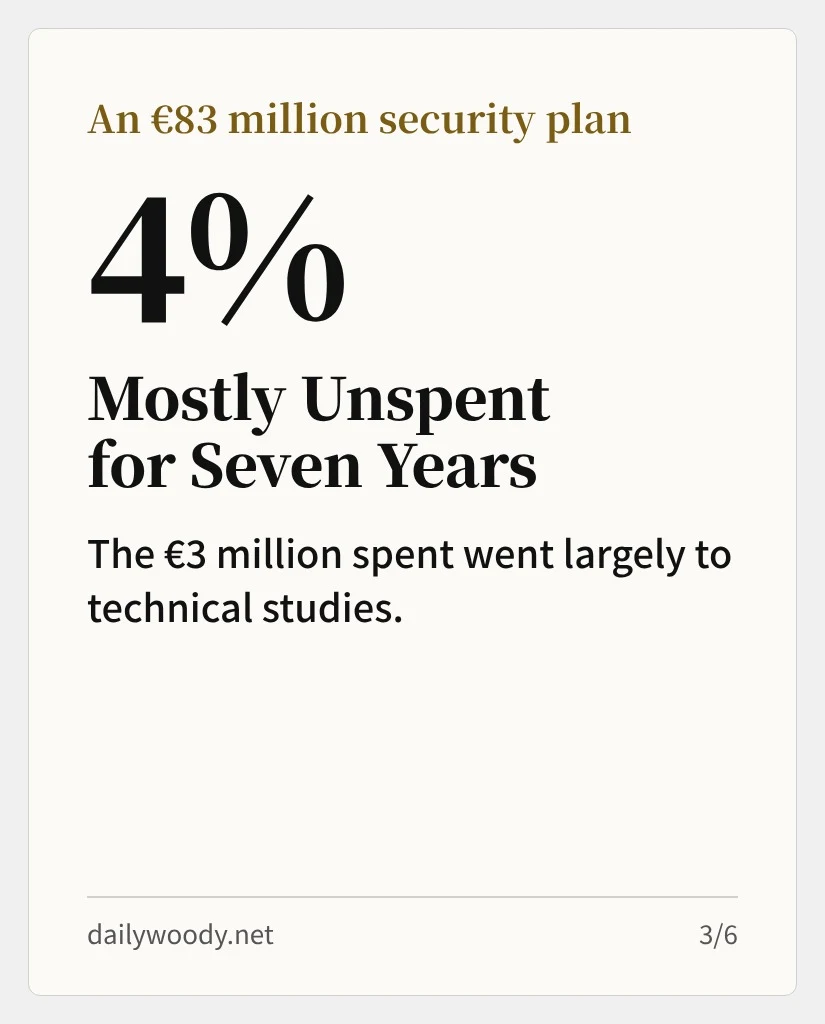
The Louvre also had a plan to overhaul its security equipment, including its cameras. It put the cost at €83 million. In November 2025, France’s Court of Audit, the independent body that checks how public institutions spend their money, published a review of the museum. From 2018 through 2024, it found, the Louvre had spent €3 million on that plan, mostly on technical studies.
The money was there. The same report called the museum’s finances very solid. The United Arab Emirates had paid the Louvre to lend its name to a museum in Abu Dhabi, and €130 million of that money was sitting in the Louvre’s accounts.
The auditors also traced where the money went. Over those seven years, the Louvre spent about €86 million on maintenance and on restoring the palace. It spent about €169 million on buying art and redesigning its galleries, nearly twice as much.
The museum favored visible and attractive operations at the expense of maintaining and renovating its buildings and technical installations, notably for safety and security.
— French Court of Audit, November 2025
A fixed share of ticket money went to art
None of this means the museum’s leaders were reckless. Buying art and refreshing galleries is what a museum is for. The more revealing detail is how the money moved.
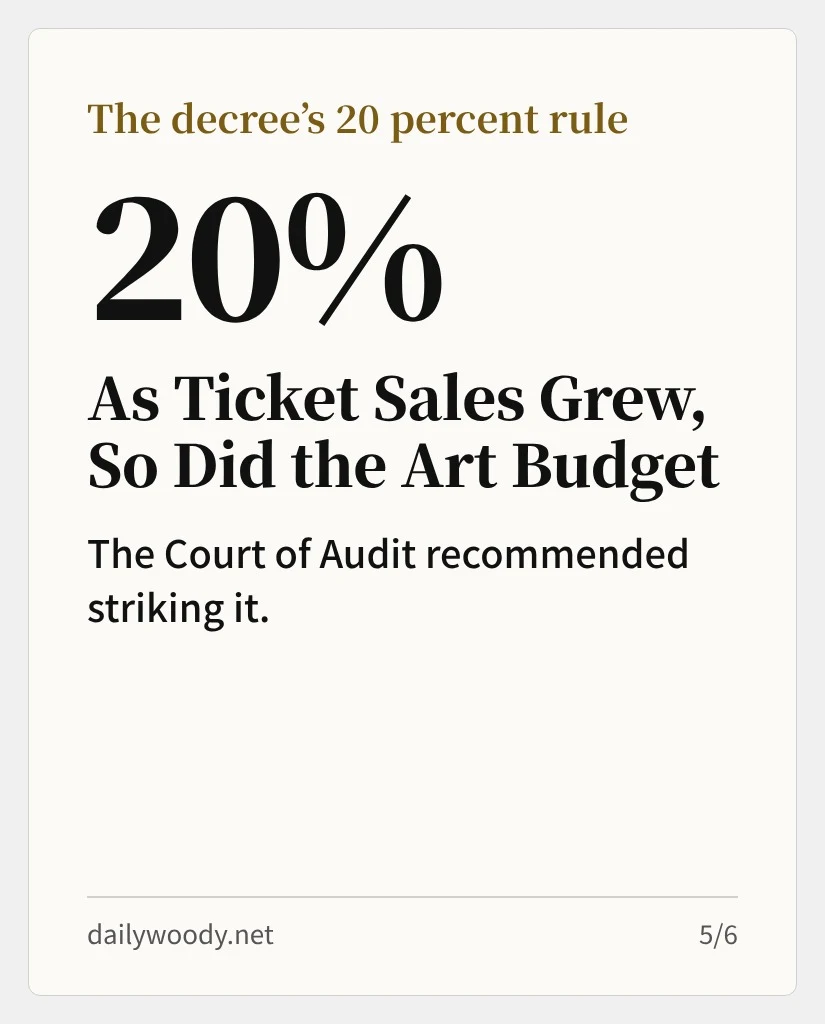
The decree that governs the Louvre reserves 20 percent of ticket revenue for acquisitions. When attendance rises or prices go up, the acquisition budget grows on its own, and no one has to argue for it. In 2024 the Louvre took in €124.5 million from tickets. By the auditors’ count, it acquired 2,754 works over eight years, and fewer than one in four went on display.
Picture someone who has a fixed share of every paycheck moved automatically into a hobby account. That money piles up without a second thought. Servicing the water heater is different. You have to book the visit and pay for it separately, and as long as the hot water runs, it can wait another month. Putting it off costs nothing, at least at first.
Security spending behaves the same way. When it works, nothing happens, so there is never anything to show for the money.
The Court of Audit recommended striking the 20 percent rule from the decree. It also told the museum to assign its own revenue first to its renovation plan and to lock in that funding for the long term.
The indicator that disappeared
The Louvre signs multiyear performance contracts with the culture ministry, which oversees it. Each goal in the contract comes with an indicator that measures progress. In 2022 the two sides added an indicator for creating a new curatorial department. At the same time, they dropped the one that tracked the museum’s technical master plans. It was the only indicator of its kind.
What no one measures, few people chase. The Court of Audit noted that maintenance spending stayed low without any intervention from the ministry. In May 2026, a parliamentary inquiry concluded that the museum’s leaders were not solely to blame. It found that goals of prestige and international influence had crowded out security.
The Louvre had its reasons. The pandemic closed the museum for 324 days and cost it, by its own estimate, more than €170 million in revenue. Martinez told senators he had kept the security plan as his top priority even as the museum’s income collapsed. AFP cited administrative delays, management decisions and red tape. None of that explains why the acquisition budget grew over the same period while the security plan sat mostly unspent.
A year later, bars on the window
Before dawn on Dec. 23, 2025, a Tuesday, when the museum is closed, a truck-mounted lift rose to the same balcony. This time it carried workers, and they fixed a metal grille over the window.
Des Cars told senators that a grille had once covered that spot. The museum took it down during a major restoration of the gallery in 2003 and 2004, and for more than 20 years no one put it back.
Other things have changed, too. Des Cars stepped down in February 2026, and Christophe Leribault replaced her. The Louvre has pledged about €20 million a year for security through 2032, and since July it has had an official in charge of security across the museum. When the Apollo Gallery reopened on July 22, it held no jewels at all. The museum plans to build a windowless strong room before it shows the remaining pieces again. Last week Leribault told Le Figaro that unless the Louvre is repaired, updated and transformed, it will quickly fall behind and eventually have to close its doors.
Restorers are working on the dropped crown. It lost 10 of its 1,354 diamonds and its frame was crushed, but the Louvre says it can be returned to its original state.
Two months after losing eight jewels, the Louvre put bars on that window. A report had singled out that balcony seven years earlier, and the window had stayed as it was. At the time, the other windows were still under discussion. We pay for the water heater only after it bursts. Then we fix the part that burst.
Sources
- Source ↗ French Court of Audit, “L’établissement public du musée du Louvre, exercices 2018-2024” (Nov. 2025)
- Source ↗ Europe 1, the audit’s breakdown of Louvre spending (Nov. 6, 2025)
- Source ↗ Public Sénat, the audit and the 4 percent figure (Nov. 2025)
- Source ↗ NPR, how the thieves got in (Nov. 1, 2025)
- Source ↗ Public Sénat, the 2018 Van Cleef & Arpels audit, citing Le Monde
- Source ↗ info.fr, the 2018 audit’s pages on the balcony, citing L’Express
- Source ↗ L’Avenir (AFP), why the audit was never handed over (Nov. 26, 2025)
- Source ↗ French National Assembly, culture committee minutes
- Source ↗ The Local (AFP), the inquiry and the 30 seconds (Dec. 10, 2025)
- Source ↗ Public Sénat, Martinez’s Senate hearing (Dec. 16, 2025)
- Source ↗ The Local (AFP), bars installed on the gallery window (Dec. 23, 2025)
- Source ↗ AP, workers on the lift (Dec. 23, 2025)
- Source ↗ Euronews, restoring Empress Eugénie’s crown (Feb. 5, 2026)
- Source ↗ LCP, the parliamentary inquiry’s report (May 13, 2026)
- Source ↗ Sud Radio (AFP), the Apollo Gallery reopens (July 22, 2026)
- Source ↗ Time Out Paris, plans for a windowless strong room, citing Radio France (July 2026)
- Source ↗ Sud Radio (AFP), the Louvre’s security a year later (Oct. 2026)
- Source ↗ Asharq Al-Awsat (AFP), the Louvre and Leribault a year on (Oct. 2026)
- Source ↗ Orange Actu, where the investigation stands (Oct. 2026)



댓글
댓글 쓰기