I Love Lucy at 75: RKO's B-Movie Actress Bought Its Studios
Woody Magazine
We write the things that aren't news
Oct. 15, 2026 (Thu.)
I Love Lucy at 75: RKO's B-Movie Actress Bought Its Studios
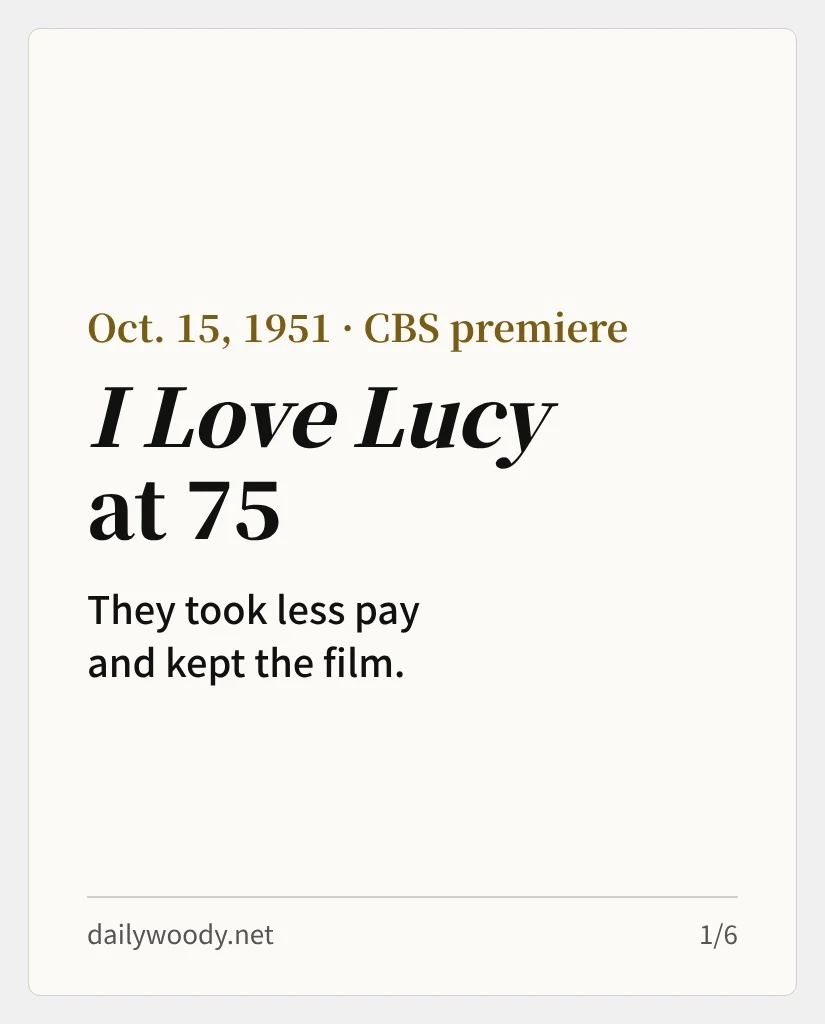
They took less pay, kept the film, and built a company on it.
In Three Lines
- In 1951, CBS wanted I Love Lucy broadcast live from New York. Lucille Ball and Desi Arnaz refused to leave Hollywood.
- They settled it by accepting less money and covering the extra cost of shooting on film, in exchange for owning every frame.
- The couple's fortune came from that film, not their salaries. In 1956, CBS paid $4.3 million for the rights.
The story goes like this. In 1939, RKO Pictures signed Orson Welles, and Welles wanted Lucille Ball to star in his first film for the studio. The front office said no. Ball, it decided, could not carry a movie.
She had been under contract at RKO since 1935, mostly in low-budget B pictures.
Eighteen years later, Ball and her husband, Desi Arnaz, bought RKO's studios.
On Oct. 15, 1951, 75 years ago tonight, their sitcom I Love Lucy premiered on CBS. It is tempting to tell the rest as a familiar success story: the show became a hit, the couple got rich, and they went back to buy the old workplace. That reading makes sense. I Love Lucy finished four of its six seasons as the highest-rated program on American television.
But the couple began the show by taking less money. What they got instead mattered more.
In 1951, television came live from New York
Most network programs went out live from New York. The networks' studios were there, and the East Coast had more households with a TV set.
Viewers in the West, three hours behind, saw a kinescope instead, a recording made by pointing a film camera at a TV monitor during the broadcast. It was a picture of a picture, and it looked soft and murky.
CBS and the show's sponsor, the cigarette maker Philip Morris, wanted I Love Lucy done live from New York, too. A live show from Hollywood would have flipped the problem. The East Coast, the sponsor's most lucrative market, would be the one watching the murky copy.
The couple wanted to stay in Hollywood
Ball and Arnaz had no intention of moving. They had lived in Los Angeles for years, and the film industry's crews and equipment were there. So they proposed shooting the show on 35-millimeter film, like a movie, and sending the film east. Every viewer in the country would see the same sharp picture.
They also wanted to keep what made Ball come alive in front of a crowd. Filming with several cameras before a live audience was a problem Arnaz handed to Karl Freund, the cinematographer of the 1931 "Dracula." Freund worked it out.
That left money. Film cost more than a live broadcast, and CBS did not want to pay the difference.
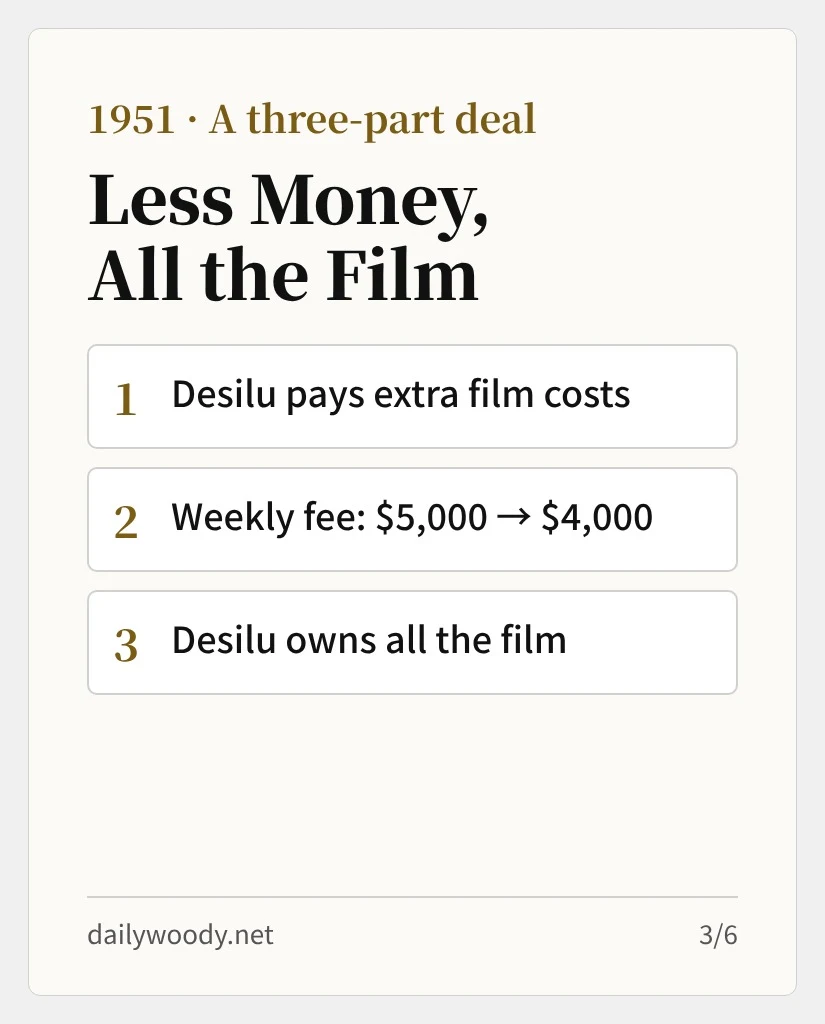
The deal had three parts. Desilu, the couple's production company, would cover the extra cost of filming. Ball and Arnaz would lower their asking fee, $5,000 a week for the two of them, to $4,000. In return, Desilu would own the negatives and prints outright.
Today it looks like a lopsided deal. Sit in CBS's chair in 1951, though, and there was little reason to hesitate. A live broadcast aired once and was gone, and selling old episodes to local stations was not yet standard practice. From where CBS sat, film looked more like an expense than an asset.
Anyone who has hired a wedding photographer knows a version of this deal. The original files cost extra, and plenty of couples pass because the album is enough. The originals stay with the photographer. If the couple wants them years later, they pay what the photographer asks.
CBS took the album and left the negatives with Desilu.
The film stayed
Film lasted, and it could be shown again at full quality. When Ball became pregnant in the second season, CBS reran earlier episodes. The reruns drew strong ratings.
By the mid-1950s, I Love Lucy was earning more than $1 million a year in reruns, and that money went to the film's owner, Desilu. Against the $1,000 a week the couple had given up, it was money on another scale.
Desilu kept growing. It shot series for other producers and made its own. Its staff grew from 12 in 1951 to 800 six years later.
In October 1956, CBS bought the film
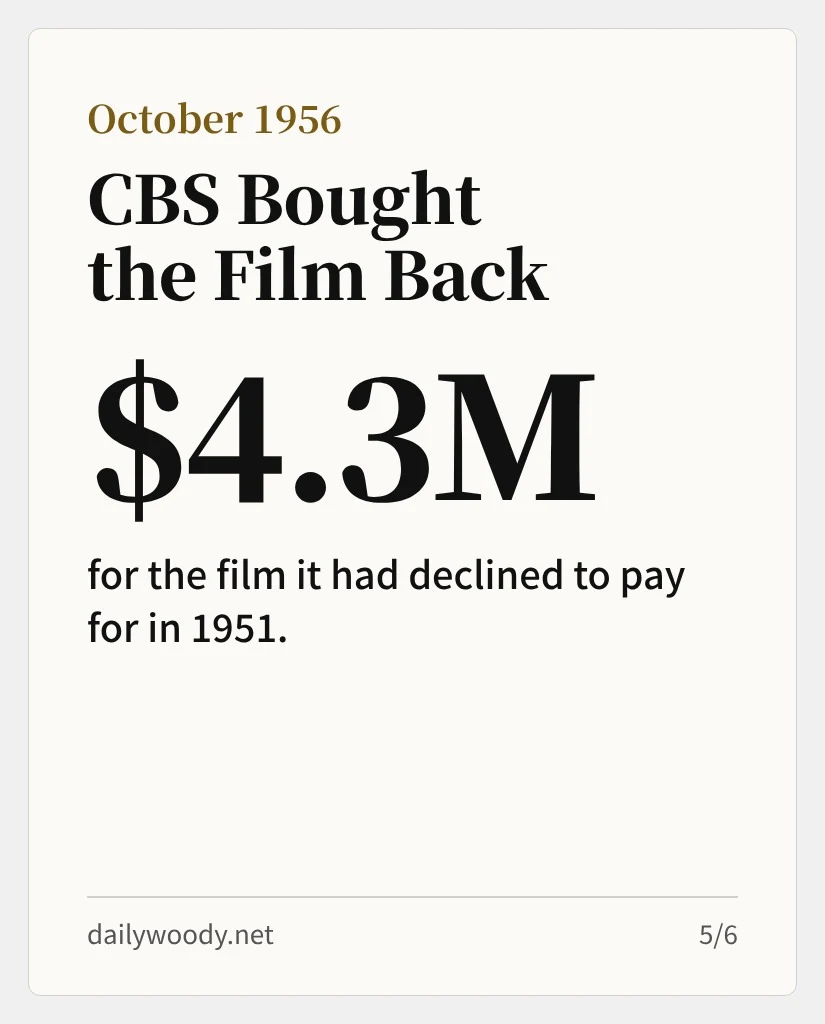
In October 1956, CBS paid Desilu $4.3 million for the rights to I Love Lucy. These were the films that had become Desilu's five years earlier, when CBS declined to pay for shooting them. The show was earning about $1 million a year in reruns. CBS was paying several years of that income up front for the originals.
The film is also why the show still looks sharp today.
In late 1957, Desilu bought RKO's studios
In late 1957, Desilu bought RKO's production facilities from General Tire and Rubber for $6 million. The deal included RKO's main lot on Gower Street in Hollywood, its studio in Culver City and a backlot.
With the purchase, Desilu had 33 sound stages, four more than MGM and 11 more than 20th Century Fox had that year. A company built on a TV sitcom now had more sound stages than Hollywood's biggest movie studios.
It was the same RKO where Ball had been called "Queen of the B's" before she left for MGM in 1942. Arnaz had once been an RKO contract player, too.
In 1951, CBS saved on the cost of filming, and the negatives stayed with Desilu. Five years later, CBS paid $4.3 million for them. Ball and Arnaz believed the film would hold its value, while CBS counted the cost of filming first. The side that asked first what the film was worth kept the negatives.
At a Glance
This story in six cards.Swipe to see more →



Sources
- Source ↗ Television Academy Interviews, “I Love Lucy” (from the Museum of Broadcast Communications’ Encyclopedia of Television)
- Source ↗ DGA Quarterly, “Classics: I Love Lucy”, Spring 2015
- Source ↗ PBS American Masters, “5 ways I Love Lucy transformed television”
- Source ↗ TCM, “Twelve Crowded Hours”
- Source ↗ TCM, “Star of the Month: Lucille Ball”
- Source ↗ MeTV, “The big time economics of 'I Love Lucy'”
- Source ↗ Wikipedia, “Desilu”
- Bart Andrews, The I Love Lucy Book (1985)

댓글
댓글 쓰기