Ford's Weekend at 100: He Promised Six Days' Pay, Not a Number
Woody Magazine
We write the things that aren't news
Sept. 25, 2026 (Fri.)
Ford's Weekend at 100: He Promised Six Days' Pay, Not a Number
"We are now working out the wage schedules," Henry Ford said in the fall of 1926.
In Three Lines
- A century ago, Ford told its factory workers they would work five days a week and be paid for six.
- The promise came with the words "according to merit," and when asked for a figure, Ford did not give one.
- This is not a claim that Ford cut pay. It is that no record we found shows what Ford actually paid.
Four-day-week trials tend to come with a formula: 100-80-100. Workers keep 100 percent of their pay, work 80 percent of the hours and deliver 100 percent of the output. The first number is the one everybody checks.
A century ago, Ford Motor Company made a version of the same promise. In 1926, it cut its factory week from six days to five. The eight-hour day stayed, so 48 hours became 40, and Saturday went blank. The usual account fits in one sentence: Henry Ford gave his workers the weekend without cutting their pay.
It is an easy story to believe. This was the company that had more than doubled its daily wage overnight twelve years earlier. But read what Ford actually said in 1926, and the promise names the days off. It never names the amount.
The five-dollar company
In January 1914, Ford raised the minimum pay in its factories. Male workers who had earned $2.34 for a nine-hour day now got $5 for eight hours, close to double what the average auto worker made.

Magneto assembly at Ford’s Highland Park plant, 1913. The next January, the company’s minimum daily pay became $5. Photo: U.S. National Archives · No use restrictions ↗
The money came with strings. Of the $5, $2.70 was a bonus, and workers qualified only if they stayed sober, saved money and kept a clean home. Ford dropped those conditions in 1921, and by then the daily minimum was $6.
The 1922 pay envelope
The five-day week did not appear out of nowhere in 1926. In March 1922, Edsel Ford, Henry's son and the company's president, explained a plan for a 40-hour week. Every man, the statement said, needs more than one day a week for rest and recreation.
The pay terms were plain. According to the Literary Digest of April 29, 1922, current workers would keep a minimum of $6 a day, and new hires would start at $5 a day. The daily rate stayed where it was. The week got shorter.
Newspapers did the arithmetic at once. The Christian Science Monitor noted that a worker on $6 a day would now find only $60 in his biweekly envelope. The Newark News said he would lose at least half a day's pay, and the Huntington Advertiser in West Virginia wrote that his earning capacity had been cut by one-sixth. The papers' sums differed, but they landed in the same place. The envelope was getting thinner.
Ford later said as much himself. In a 1926 magazine interview, he acknowledged that the company had run on a five-day basis for much of that time, "but we have paid only for five days and not for six." Whenever a department got especially busy, he added, it went back to 48 hours.
The fall 1926 interview
The Henry Ford museum's chronology of Ford Motor Company dates the 40-hour week to May 1926 for factory workers and Aug. 1 for office staff. The public announcement came at the end of September, and the records disagree a little on when the change actually began. A Christian Science Monitor article from Sept. 27, cited by the Library of Congress, reported that some departments had been working that way since July.
That fall, Ford laid out the plan in an authorized interview with the journalist Samuel Crowther, published in the October 1926 issue of World's Work. From now on, he said, there would be no work on Saturdays and Sundays, "but the men, according to merit, will receive the same pay equivalent as for a full six day week."
Crowther pressed him. Did that mean the $6 daily minimum would rise to a little over $7, so that the minimum for five days' work would still be $36, as it had been for six?
"We are now working out the wage schedules," Ford answered. "We have stopped thinking in terms of a minimum wage." So few people earned the minimum anymore, he said, that the company did not bother about it. "We try to pay a man what he is worth, and we are not inclined to keep a man who is not worth more than the minimum wage."
Anyone who has read an American job listing knows the shape of that answer. The ad spells out the days and the hours. Under pay, it says "commensurate with experience." The employer sets the figure, and the applicant learns it after being hired. Ford's promise read the same way. The days off were in writing. Under pay, it said "according to merit" and "working out the wage schedules."
The number missing from the government report
Skepticism was reasonable. In the New York Times of Oct. 17, 1926, Elbert H. Gary, chairman of U.S. Steel, said workers would not want a five-day week unless they got six days' pay for it, and employers could not afford that. "It is illogical to work only 5 days a week and get paid for 6," he said. Then he quoted Scripture: "Six days shalt thou labor and do all thy work."
The federal Bureau of Labor Statistics was paying attention too. Its Monthly Labor Review for December 1926 opened with the five-day week. Ford's announcement had stirred interest, so the bureau gathered what its own surveys showed. The five-day week, the bureau concluded, was not as uncommon as the current debate suggested. In men's clothing, 45 percent of the establishments it covered already ran on five-day weeks.
Yet the same issue's section on the Ford plants contains no survey figures at all. It reprints the World's Work interview almost in full. For other industries, the bureau reported percentages. For Ford, it printed the owner's own words. In effect, it posted a job ad with the pay line left blank. The report did not say what Ford actually paid.
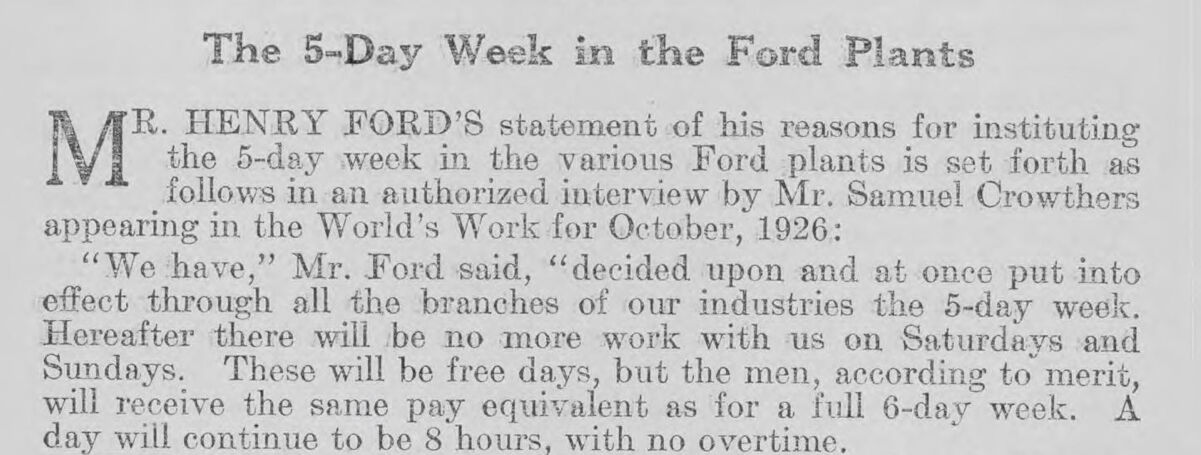
Monthly Labor Review, December 1926, page 10. The bureau’s Ford entry opens with a quotation from the World’s Work interview, not with survey figures. Source: U.S. Bureau of Labor Statistics, via FRASER (Federal Reserve Bank of St. Louis) · Public domain ↗
Not much has changed since. Plenty of accounts say the five-day week came with no cut in pay, but in our search, none cited what Ford workers actually earned per week after 1926. Nor did we find any record that Ford cut their pay. What the record holds is the promise, and an answer that stepped around the question of how much.
People with time off buy things
So why did Ford clear out Saturday? The interview is blunt about it. There is a humanitarian side to shorter hours, Ford said, but dwelling on it "is likely to get one into trouble."
The business fact was consumption. "The people who consume the bulk of goods are the people who make them," Ford said. People with more leisure need more clothes, a greater variety of food and more ways to get around. A workman kept in the shops from dawn until dusk, he argued, would have little use for a car.
He had a point, and he was not the only one making it. In the Oct. 17 Times, Sidney Hillman, president of the Amalgamated Clothing Workers of America, a garment union, said more leisure would create demand for new goods and services. In the fall of 1926, Ford and the unions agreed that people with time off spend money. Where they split was pay. William Green, president of the American Federation of Labor, said in the same pages that as productivity rose, wages had to rise first.
The Saturday Ford promised made it onto the calendar, and a century later it is still on ours. The amount never made it into the promise. The side that writes "commensurate with experience" is always the side doing the hiring.
Sources
- Source ↗ Samuel Crowther, "Henry Ford: Why I Favor Five Days' Work With Six Days' Pay," World's Work, October 1926 (Wikisource)
- Source ↗ U.S. Bureau of Labor Statistics, Monthly Labor Review, December 1926 (FRASER, Federal Reserve Bank of St. Louis)
- Source ↗ "Henry Ford's Five-Day Week," Literary Digest, April 29, 1922 (Teaching American History)
- Source ↗ Library of Congress, Inside Adams, "40 Hours, 5 Days" (2024)
- Source ↗ The Henry Ford, Ford Motor Company Chronology
- Source ↗ History.com, "Ford factory workers get 40-hour week"
- Source ↗ 4 Day Week Global, "What is the 100:80:100 rule for the 4 day week?"
- Source ↗ World Economic Forum, "The world's biggest trial of the four-day work week has come to an end" (2023)





댓글
댓글 쓰기