Halloween Week: The "Mare" in Nightmare Was Never a Horse
Woody Magazine
We write the things that aren't news
Oct. 28, 2026 (Wed.)
Halloween Week: The "Mare" in Nightmare Was Never a Horse
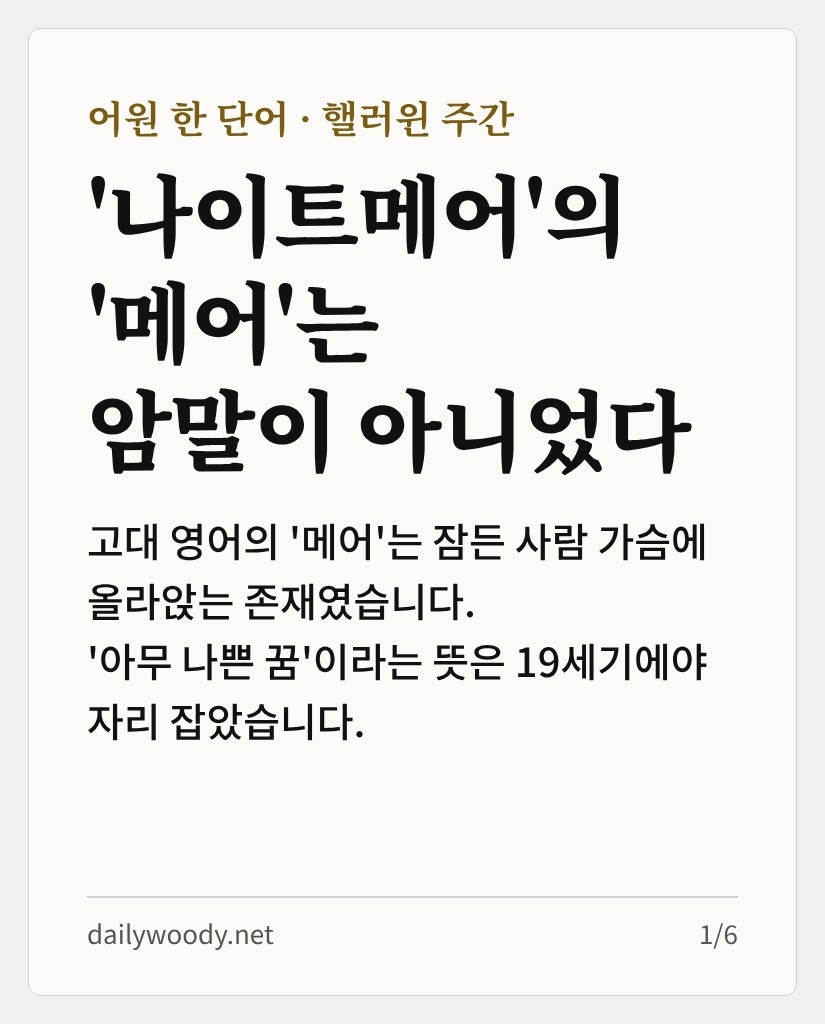
In Old English, a mare was something that sat on sleepers' chests. The everyday sense, any bad dream, settled in only in the 19th century.
At a Glance
This story in six cards.Swipe to see more →
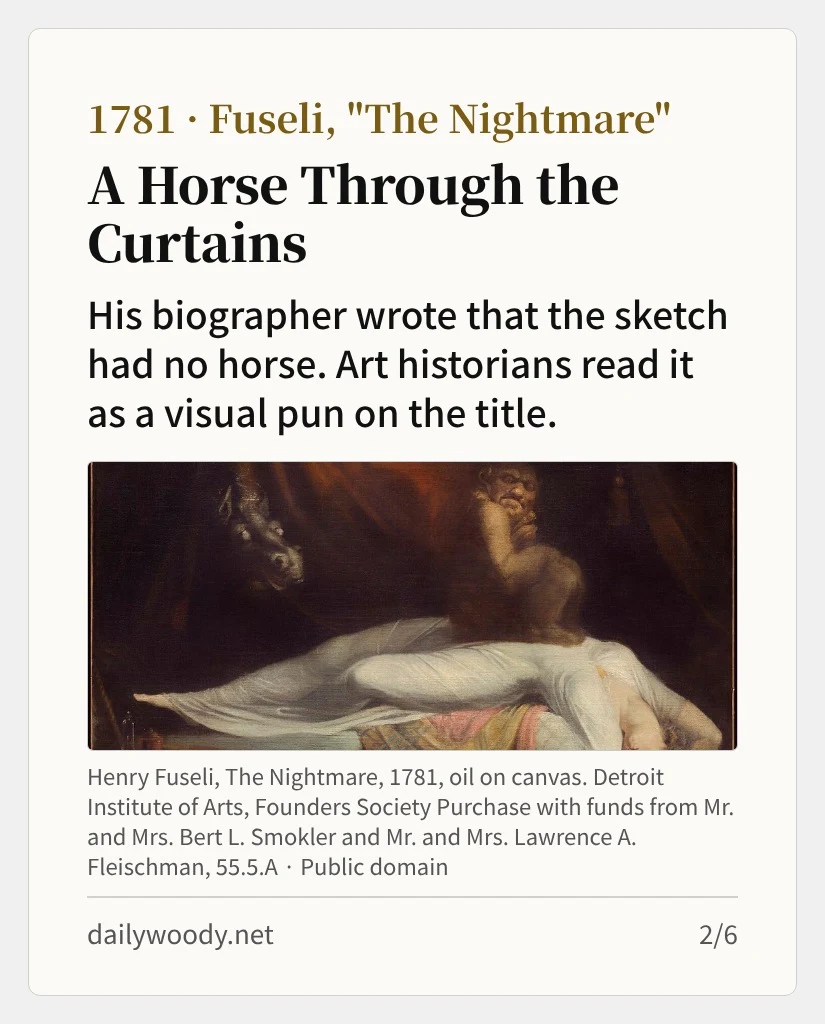


In 1781 the Swiss-born painter Henry Fuseli finished "The Nightmare." A woman lies asleep with her head dropped over the edge of the bed. A small, hairy demon crouches on her chest. Through a gap in the curtains, a horse pushes in its head, eyes blank.
A mare is a female horse, so the animal seems to explain the title. Read the word as a mare that comes at night, and the story is tidy.
It is also wrong twice. The mare in nightmare was never a horse, and the word started out as the name of a creature, not a dream.
Think of the word as an old shop sign. The lettering has hung in roughly the same place for more than 700 years. It has sold three different things underneath, and in the meantime passersby started reading the sign as something else.
In Old English, the mare sat on people
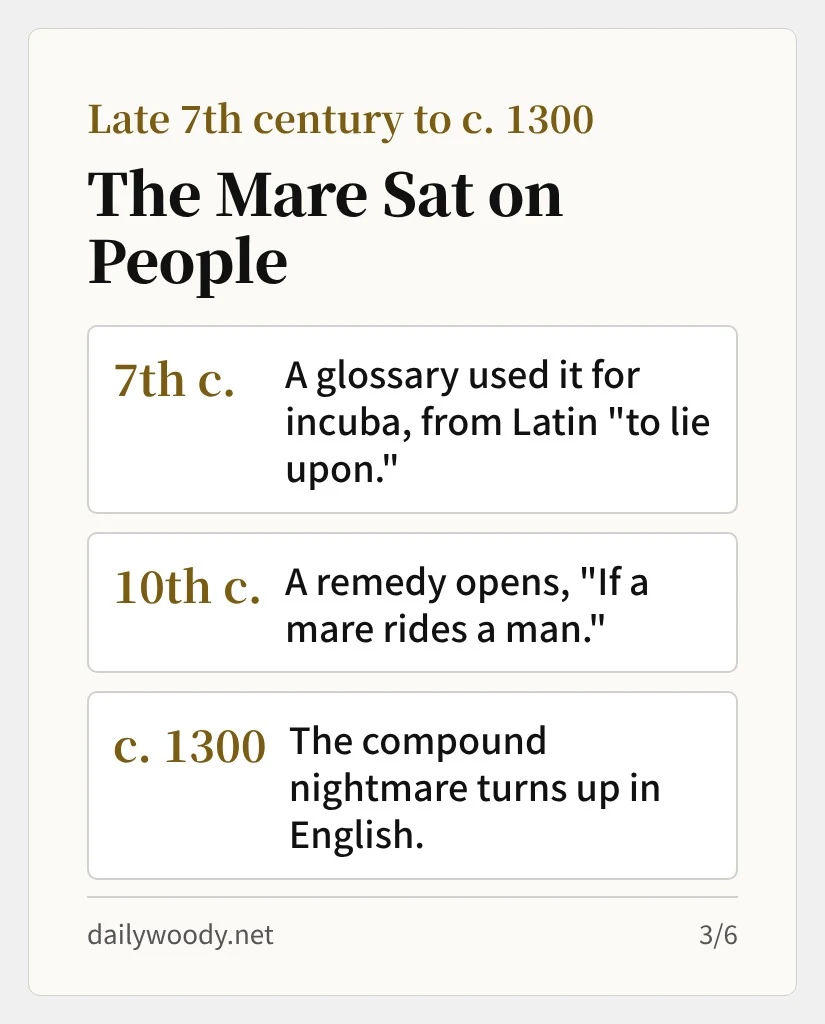
The mare is about as old as written English. The Épinal Glossary, a late seventh-century list that set Old English words beside Latin ones, uses it for the Latin incuba, from a verb meaning "to lie upon." Working partly from that gloss, Alaric Hall, then at the University of Helsinki, argued in a 2007 paper that the creature was probably always imagined as female.
There was a cure, too. Bald's Leechbook, a medical book copied before the middle of the 10th century, has a remedy that opens, "If a mare rides a man." It calls for lupins, garlic, betony and frankincense, bound in a fawn's skin and carried on the body.
Scandinavians called it the mara. Around 1225 the Icelandic historian Snorri Sturluson wrote the Ynglinga saga, and in it a mara kills a king. Vanlandi, a legendary king of Sweden, promised his wife Drífa he would return within three years. Ten years passed. She paid a sorceress to bring him back or kill him.
Soon after he fell asleep, he cried out that the mara was trampling him. When his men held his head, it crushed his legs. When they moved to his legs, it pressed on his head until he died.
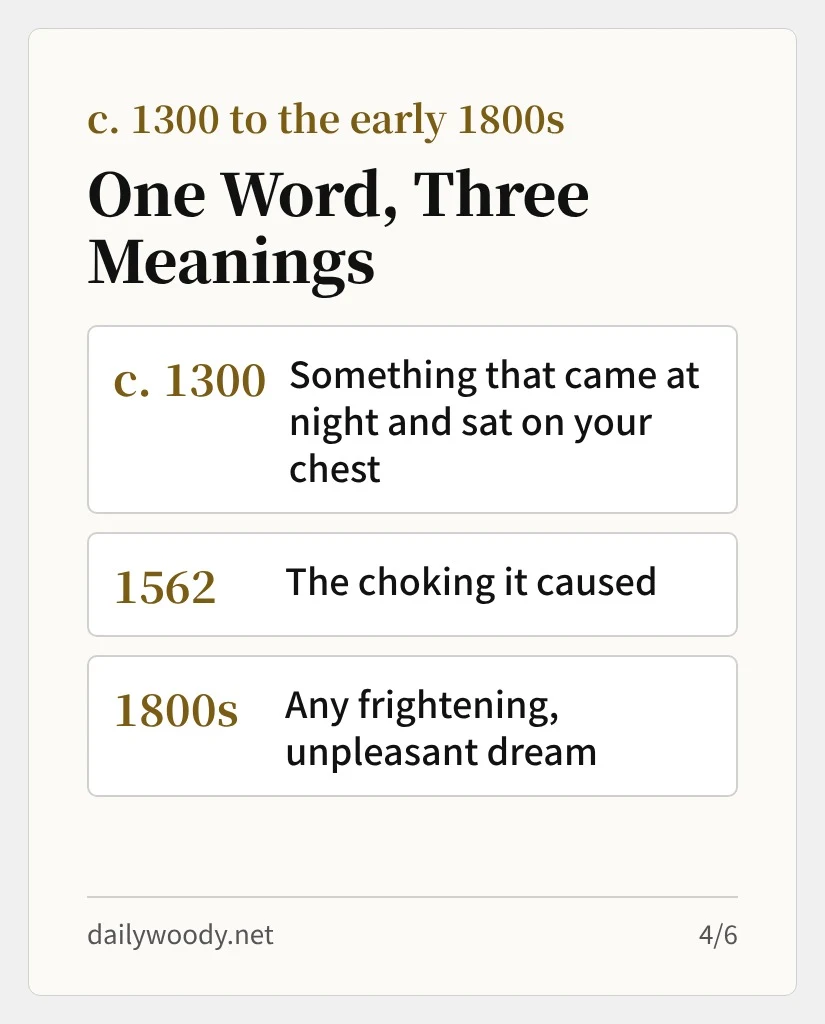
The compound nightmare turns up in English around 1300, in a passage on St. Michael in the South English Legendary, a collection of saints' lives. It describes evil spirits that harm people in their sleep and lie on top of them, and says people call this the nightmare. When the sign first went up, what hung beneath it was not a dream. It was the name of something that came at night and sat on your chest.
In the 16th century, the name moved from creature to symptom
In the 16th century the word began to point less at the visitor than at the choking it caused. William Turner, an English botanist and physician, offered "a good remedy agaynst the stranglyng of the nyght mare" in his herbal of 1562. The goods under the sign had changed for the first time. By the 17th century the word could also mean a bad dream that brought on that choking.
Anyone who has had it will recognize the shift. It feels less like a dream than like being pinned. The mind is awake, but the body will not move. Something seems to sit on the chest. Doctors call it sleep paralysis. The muscle slackness of REM sleep, the stage in which most vivid dreaming happens, lingers for a while after consciousness has come back.
Among students in the same review, the figure was 28.3%, more than 1 in 4. Plenty of people still have nights much like the ones the Anglo-Saxons blamed on a mare 1,300 years ago. The Detroit Institute of Arts, which owns Fuseli's painting, lists in its bibliography a Journal of the American Medical Association article titled "Henry Fuseli, Nightmare, and Sleep Paralysis."
Other languages named the same feeling. French cauchemar joins an old verb meaning to press or trample to the same Germanic mare. Spanish pesadilla adds a diminutive ending to the word for weight. The Royal Spanish Academy's dictionary still lists an obsolete sense of pesada as a tightness in the chest and difficulty breathing during sleep. Korean puts the weight in the verb. Koreans say gawi-e nullida: to be pressed down by gawi, the word for the state itself.
The horse was a different word all along
It is hard to blame anyone who read the word as a night horse, because the horse word had a tangled history of its own. Old English had mearh, "horse," and mīre, "female horse." The Oxford English Dictionary treats modern mare as a merger of the two, with the spelling of the first and the meaning of the second. During the Middle Ages, the horse and the night monster landed on the same four letters.
Then the monster's mare stopped standing on its own. Used by itself, it lasted until about the 17th century and after that survived only inside nightmare. Left with a mare they no longer recognized, people read it as the one they knew. Passersby had reread the sign.
Fuseli's horse looks different in this light. His friend and biographer John Knowles wrote that the preparatory sketch had no horse and that Fuseli added it before the painting was shown. Art historians read it as a visual pun on the title. The canvas made Fuseli's name at the Royal Academy in London in 1782, and an engraving spread it widely the following year.
Bad dreams in general arrived in the 19th century
Noah Webster's "American Dictionary of the English Language" of 1828 gives mare two meanings side by side. The first is the female horse. The second is a kind of torpor that seems to press on the stomach in sleep. After the second, Webster added a note.
"It is now used only in the compound, nightmare, which ought to be written nightmar."
It is easy to see the appeal, since dropping one letter would part the word from the horse. It was a fitting proposal from the man who pushed Americans toward spellings like color. The spelling never caught on.
By then the third item was spreading out under the sign. The 17th-century sense covered only dreams that came with choking. The Oxford English Dictionary dates the broader sense, "an oppressive, frightening, or unpleasant dream," to the early 19th century. Among its examples is the journal of the Scottish novelist Sir Walter Scott. On Nov. 29, 1826, he woke from horrid dreams and wrote, "I had the nightmare in short, and no wonder." By the 1830s the word could also mean any very distressing experience, the sense in a nightmare commute.
Nightmare began as a name for nights when the chest was pinned and the body would not move. Once mare stopped being used on its own, people read the letters as a horse, and in time dreams moved in under the sign. A dictionary maker wanted the lettering changed. The sign stayed up. Signs rarely change. What they sell does.
Sources
- Source ↗ Bosworth-Toller Anglo-Saxon Dictionary, "mære"
- Source ↗ Middle English Dictionary (University of Michigan), "māre n.(2)"
- Source ↗ Alaric Hall, "The Evidence for maran, the Anglo-Saxon Nightmares," Neophilologus 91 (2007)
- Source ↗ T. L. Burton, "What Sex is a Mare? Horses and Mares in William Barnes's Dialect Poems," Notes and Queries 63(2), 2016
- Source ↗ Online Etymology Dictionary, "nightmare"
- Source ↗ Online Etymology Dictionary, "mare"
- Source ↗ Grammarphobia, "The mare in nightmare" (2018)
- Source ↗ Wordorigins.org, "nightmare"
- Snorri Sturluson, "Ynglinga saga" (Heimskringla, part 1), c. 1225
- Source ↗ Detroit Institute of Arts, Henry Fuseli, "The Nightmare" (55.5.A)
- Source ↗ Artsper Magazine, "Henry Fuseli's The Nightmare"
- Source ↗ Sharpless and Barber, "Lifetime prevalence rates of sleep paralysis," Sleep Medicine Reviews 15(5), 2011
- Source ↗ Noah Webster, American Dictionary of the English Language (1828), "mare"
- Source ↗ La langue française, "cauchemar"
- Source ↗ Real Academia Española, Diccionario de la lengua española, "pesada"
댓글
댓글 쓰기