NYC Marathon Tomorrow: The Five-Borough Route Was a One-Off
Woody Magazine
We write the things that aren't news
Oct. 31, 2026 (Sat.)
NYC Marathon Tomorrow — Fifty Years Ago, the Five-Borough Route Was Meant to Run Once
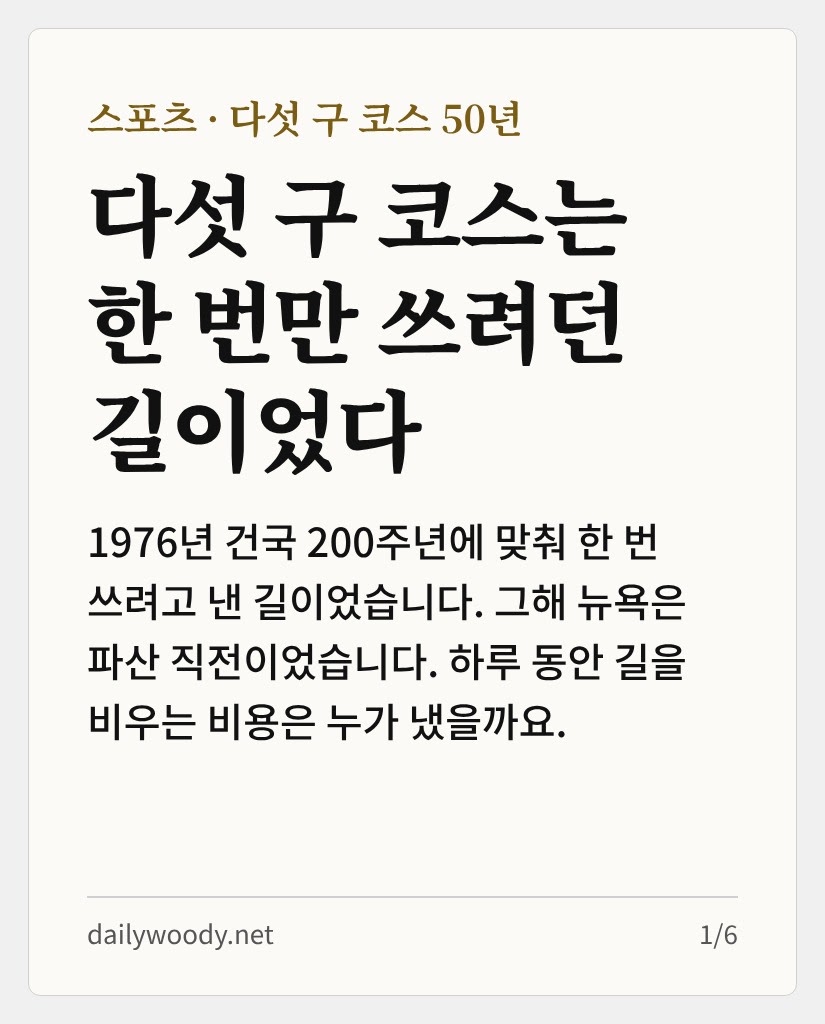
In 1976 a city near bankruptcy closed its streets for a day. Who paid for it explains why nobody asked to stop.
At a Glance
This story in six cards.Swipe to see more →


Tomorrow morning the New York City Marathon leaves Staten Island, crosses five bridges, runs through all five boroughs and finishes in Central Park. Last year more than 59,000 people ran the whole way.
Because the race follows the same route every year, it is easy to assume it has always looked like this. It hasn't. The five-borough course was laid out in 1976 for the nation's Bicentennial, and it was meant to be used once. That year New York was close to bankruptcy.
A broke city cannot close 26.2 miles of streets unless someone covers the bill. Who covered it explains why the race never went back to the park.
Four laps of Central Park
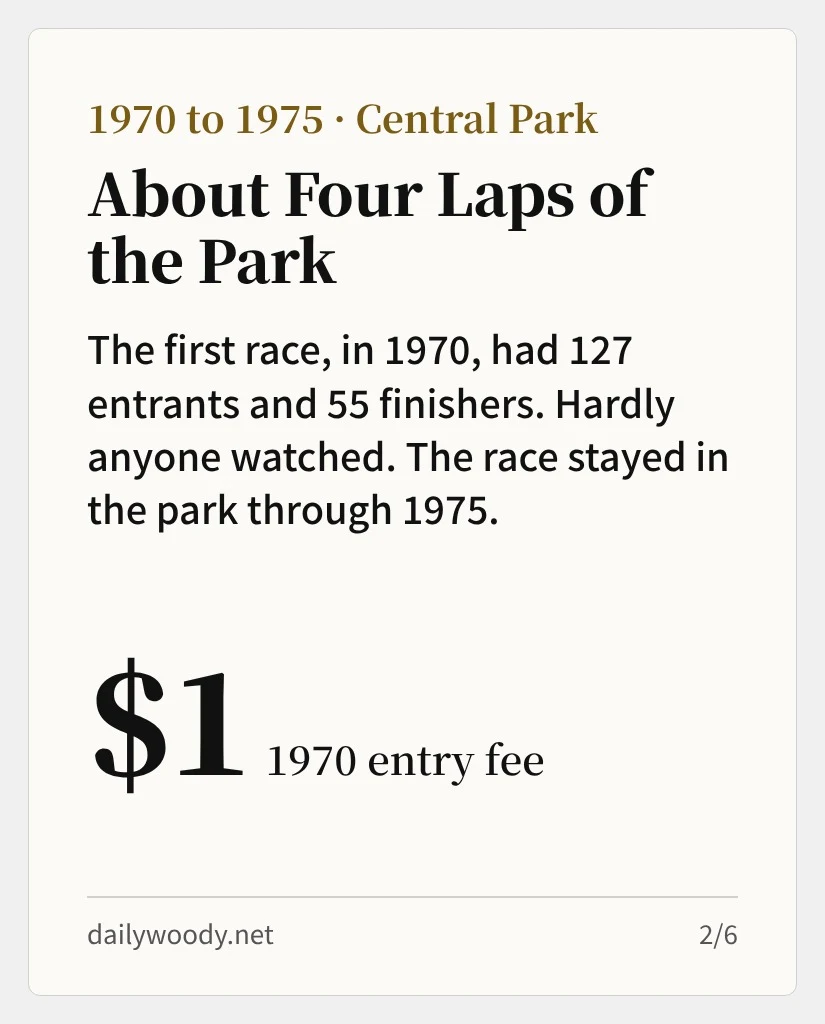
The first New York City Marathon was held in Central Park in September 1970. Runners looped the park drive about four times, and the entry fee was $1. Of 127 entrants, one was a woman. Fifty-five finished.
Hardly anyone watched. George Hirsch, then a magazine publisher and a runner, later helped build the race. He recalls that in those years most people in the park just happened to be there. The race stayed inside the park through 1975.
A city without money
In 1976 came a proposal to leave the park and run through every borough. New York Road Runners, the nonprofit club that runs the marathon, now credits the idea to the distance runner Ted Corbitt and George Spitz, a city employee.
Fred Lebow, the race director, said no at first. Born in Romania, he worked in the garment district and had organized the 1970 race with Vince Chiappetta, then the club's president. Hirsch remembers Lebow's reaction:
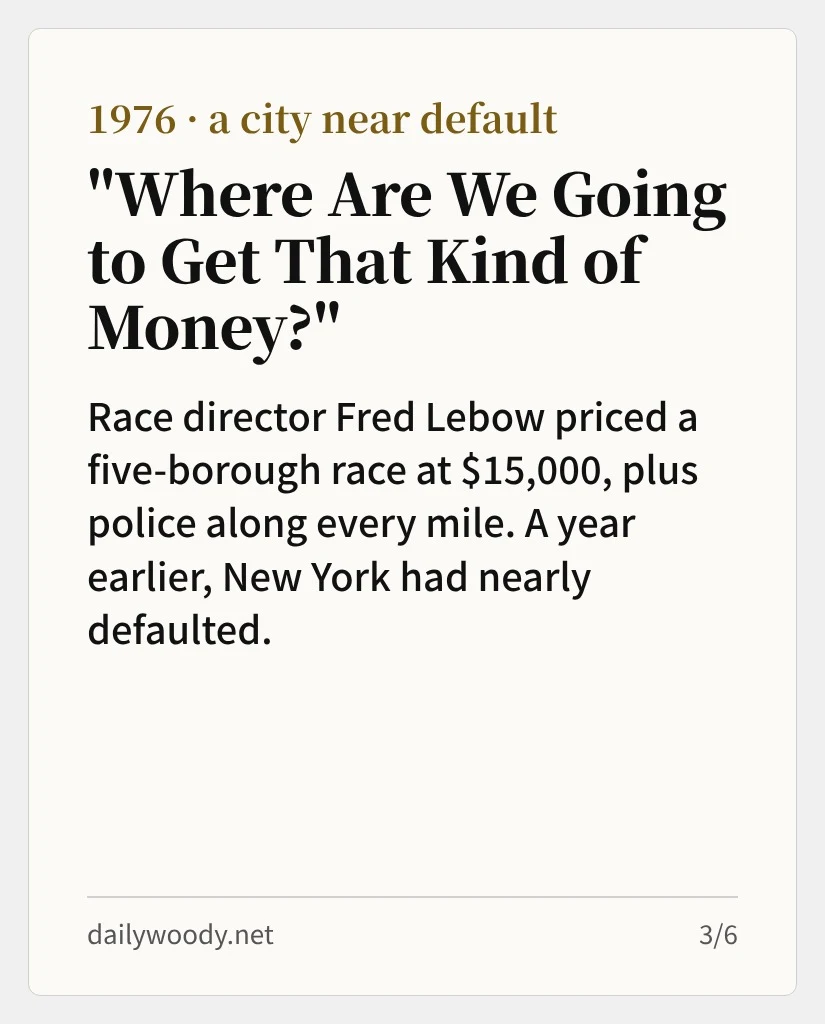
"A race like that could cost $15,000. Where are we going to get that kind of money?"
Lebow had reason to hesitate, and the city was in worse shape than he was. In 1975 New York had come close to defaulting on its debts, and crime was high. Closing 26.2 miles for a day meant posting police along the entire course.
The brothers who wrote the check
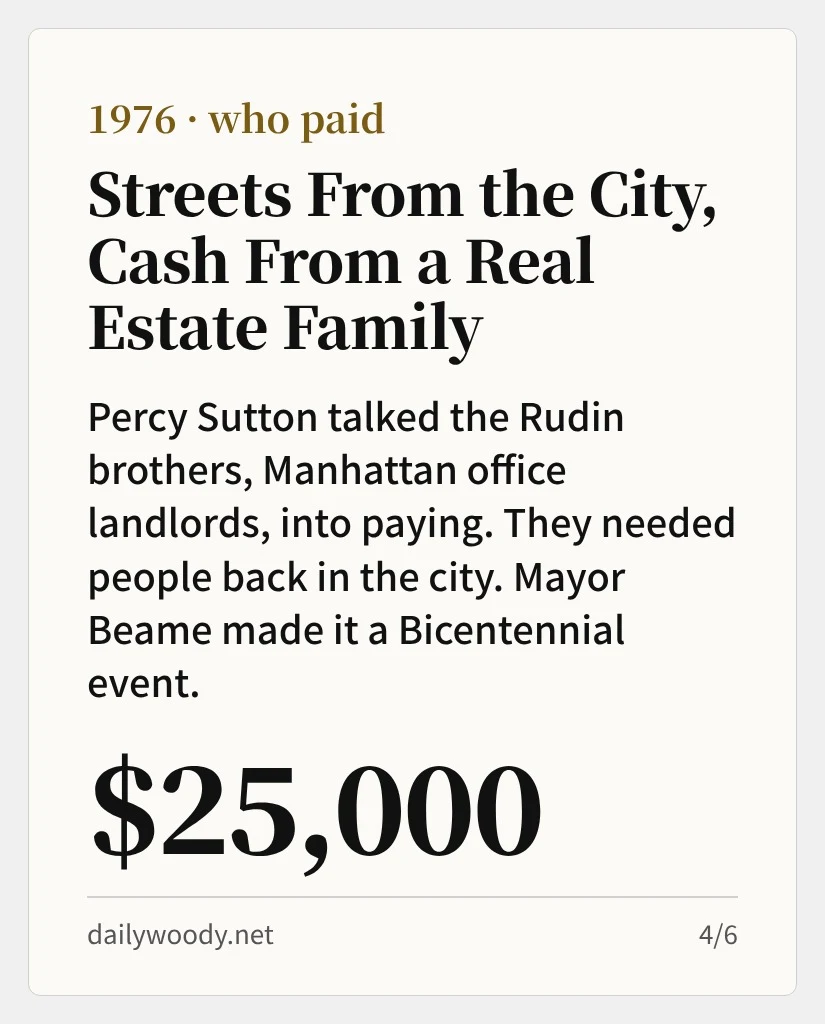
Percy Sutton, the Manhattan borough president, changed the math. He persuaded Jack and Lewis Rudin, brothers who ran a family real estate firm, to put up $25,000.
The Rudins owned office buildings across Manhattan. In 1971 Lewis Rudin had helped found the Association for a Better New York, whose business leaders set out to sell the city to companies at a time of rising fear about crime. The brothers also wanted to honor their late father, Samuel, a distance runner, and the winners' trophy still carries his name.
By Hirsch's account, three more sponsors added another $25,000, bringing sponsorship for the first five-borough race to about $50,000.
The city lent the streets
Mayor Abraham Beame folded the marathon into the city's Bicentennial program. With the mayor on board, the streets could be closed and police posted along the route. Hirsch recalls that he, Sutton and Lebow told Beame the city needed the marathon to lift its spirits.
City Hall may have had its own math. A 2018 essay in Public Seminar argues that Sutton saw the race as cheap marketing pegged to the Bicentennial. He also persuaded Beame to cover overtime for police and sanitation workers.
Think of a block party paid for by the local merchants' association. The shop owners chip in because a crowded street is good for business. City hall may lend the street, but the people who own the storefronts put up the money. In effect, New York's 1976 race was paid for the same way, by people who needed customers back on the street.
Two envelopes
A party needs a headliner. To get newspapers and television to cover the race, the organizers needed famous runners. They brought in Frank Shorter, the 1972 Olympic marathon champion, and Bill Rodgers, the 1975 Boston Marathon winner.
Each received an envelope with a $3,000 check from Hirsch. The payments were legal, but they broke the rules of the sport's governing body, which treated marathoners as unpaid amateurs. Hirsch described them to The Associated Press 40 years later, and the official history NYRR released this year says the same.
The same route the next year
On Oct. 24, 1976, 2,090 runners registered and 1,549 reached the finish in Central Park. Rodgers won, and Shorter was second. The last park race, in 1975, had 534 starters.
The bigger change was along the curb. A race once watched by people who happened to be in the park drew tens of thousands of spectators across five boroughs. As a way to show off the city, it drew a crowd in its first year.
The founders saw it as a single event, according to Amby Burfoot, a former Boston Marathon winner and longtime running journalist. Yet after 1976, Hirsch has said, nobody asked whether the citywide race should be run again. As the race grew, the Rudin family stayed on as a major sponsor.
The race has covered the five boroughs every year since, except 2012, when Hurricane Sandy hit, and 2020, during the pandemic. This year's finishers will receive a medal made for the route's 50th anniversary.
When a block party brings in customers, the merchants pass the hat again the next year. New York's five-borough marathon was that kind of party, and the crowds came in its first year. So the hat went around again.
Sources
- Source ↗ Marathon Handbook, "Fifty Years On, New York Honors the Five Who Took the NYC Marathon Out of Central Park" (on NYRR's 2026 announcement)
- Source ↗ The Associated Press via CBS News, "Racing at middle age: NYC Marathon marks 40th anniversary today" (Nov. 6, 2016)
- Source ↗ DNAinfo, "7 Things We Learned About the City's First 5-Boro Marathon" (Nov. 4, 2016)
- Source ↗ World Athletics, New York City Marathon 50th anniversary feature
- Source ↗ Amby Burfoot, "Out of the Woods and Into the Streets" (Marathon Handbook, Oct. 26, 2026)
- Source ↗ CBS New York, "New York Road Runners Honor Visionary Of Five-Borough Marathon"
- Source ↗ Rudin Management, Company Timeline
- Source ↗ Public Seminar, "Rat Race" (2018)
- Source ↗ GlobeSt, "Lewis Rudin Dead at 74" (Sept. 21, 2001)
- Joe Merton, "John Lindsay, the Association for a Better New York, and the Privatization of New York City, 1969-1973," Journal of Urban History 45(3), 2019
- Source ↗ The Associated Press, "New York Marathon too big, director says" (Nov. 4, 1986, Texas A&M newspaper archive)
- Source ↗ New York Real Estate Journal, tribute to Jack Rudin
- Source ↗ Encyclopedia.com, "Rudin"
- Source ↗ Scripps News, "2026 NYC Marathon medal honors the course that changed the race forever"
- Source ↗ MarathonGuide, "The Ultimate Guide to the New York City Marathon"
댓글
댓글 쓰기