Niagara Barrel Ride at 125: Her Manager Took the Barrel
Woody Magazine
We write the things that aren't news
Oct. 24, 2026 (Sat.)
Niagara's First Barrel Ride Turns 125 — Her Manager Took the Barrel and Left Her Behind
On Oct. 24, 1901, her 63rd birthday, Annie Edson Taylor became the first person to go over Niagara Falls in a barrel and live. In her later years, she sold postcards sitting beside one.
At a Glance
This story in six cards.Swipe to see more →




On Nov. 2, 1901, the last day of the Pan-American Exposition in Buffalo, a 63-year-old widow sat on a bandstand while thousands of visitors filed past. The exposition was a world's fair showcasing industry from across the Americas, held about 20 miles from Niagara Falls. Nine days earlier, Annie Edson Taylor had gone over those falls inside a wooden barrel and climbed out alive.
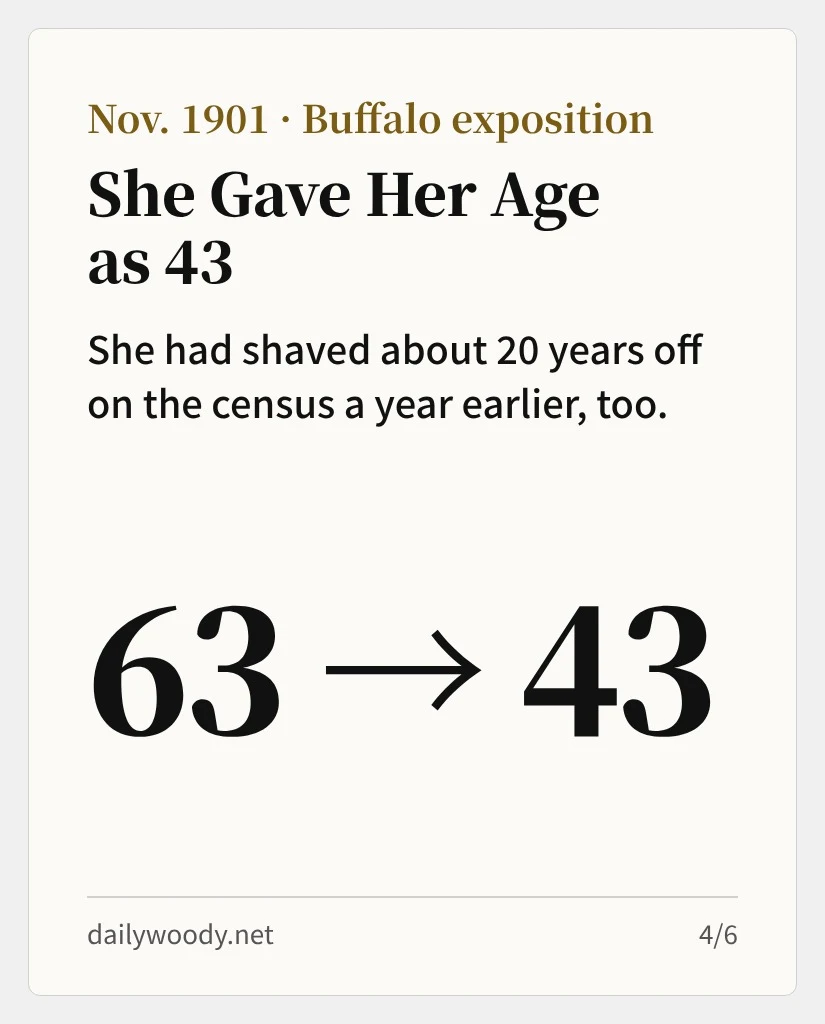
She was not alone on the stand. The barrel was there, along with the straps that had held her in place and the bicycle pump used to force air inside. So was a black cat that had made the same plunge in the same barrel six days before she did. A reporter for The Buffalo Evening News looked her over and wrote that she appeared "fully the 43 years that she admits." She was 63.
The usual version of her story is a sad one. A brave older woman makes history, falls in with a crooked manager, loses everything and dies poor. Most retellings follow that line, and it is not wrong. But look at the bandstand again and a question comes up: were the crowds lining up to see Taylor, or the whole display? Think of a ballpark, where children line up for a photo with the team mascot. Nobody asks who is inside the suit.
A Way Out of the Poorhouse
Taylor was born in New York State in 1838. She was widowed young and spent the decades that followed moving from city to city, working as a schoolteacher and as an instructor in dance and physical culture. By her 60s, her students had thinned out and her savings were nearly gone.
At the end of that road stood the poorhouse, the county-run institution where Americans with no money and no family to take them in were sent to live out their days. Taylor was determined not to end up there.
For two years she had been trying to work out how to make money "honestly and quickly." In 1901, in Bay City, Michigan, she was reading a newspaper item about the exposition in Buffalo. Then the answer came, as she put it in her memoir the following year, "like a flash of light": "Go over Niagara Falls in a barrel."
The plan looks reckless now, but the arithmetic was simple. No one had survived the falls in a barrel. Whoever did would be famous, and fame could be turned into a lecture circuit that would carry her through old age. To handle the business side, she took on Frank M. Russell, a promoter of carnivals and street shows. That left the barrel. Taylor designed it herself, cutting a pattern from paper and sewing it together, and a cooper in West Bay City built it from Kentucky oak bound with iron hoops. It weighed 160 pounds. She padded it with cushions and fitted it with a harness to hold her steady.
4:05 p.m., Oct. 24, 1901
Oct. 24 was Taylor's 63rd birthday. That afternoon her crew took the barrel by boat to Grass Island, a small island in the upper Niagara River. She climbed in, the crew pumped in air through a tube, and Taylor corked the tube from inside. At 3:50, a boat began towing her into the Canadian current. At 4:05, they let her go.
The barrel tumbled through the better part of a mile of rapids and went over the Horseshoe Falls, the curved Canadian section of Niagara, a drop of more than 150 feet. Below the falls, the current carried the barrel against the rocks near shore. When men opened it, Taylor was close to unconscious. Apart from a cut on her head, she was largely unhurt.
The line she is best remembered for came afterward:
"Nobody ought ever do that again."
It was that dangerous, and that rare. Nobody else made the trip and survived for another decade, until Bobby Leach went over in 1911. Newspapers soon gave Taylor a nickname: the Queen of the Mist.
A Department Store Window in Cleveland
The papers could not agree on her age. The Boston Journal, reporting the next day, said she was 50. Exposition advertising and other papers said 43, the age Taylor herself claimed.
It was a lie, but not one she invented for the falls. A year earlier, she had shaved about 20 years off her age on the federal census. In her 1902 memoir, she gave her birth year as 1855. For a widow who had supported herself by teaching for nearly 40 years, age was a number tied directly to whether she found work. The people who bought lecture tickets wanted a vigorous heroine, too. Taylor knew audiences paid more for a younger face long before she went over the falls.
On stage, though, Taylor was far from that heroine. At the exposition, the same reporter described her as looking like a woman just risen from a sickbed. The lectures went poorly. Sherman Zavitz, the official historian of Niagara Falls, Ontario, has said she lacked the presence to carry a stage.
One of the jobs that came instead was a department store window in Cleveland. During the Christmas shopping season she sat behind the glass for an hour a day, the barrel and the cat beside her. The first person to survive Niagara Falls had been hired to sit where shoppers could stare at her.
Then, partway through the tour, Russell left with the barrel. Taylor hired detectives to track it down, and most of her savings went to paying them. In the memoir, she called choosing Russell her "great mistake."
The Barrel Turns Up in Chicago
At this point Russell looks like the villain, and the story looks tidy: a crooked manager robs an old woman of her livelihood. Then the same thing happens again.
The barrel eventually turned up in Chicago. Taylor got it back, returned to Niagara Falls, found a new manager and went back on the road. Partway through that tour, the new manager split with her and took the barrel too.
While the barrel was out of her hands, several accounts say, a much younger woman toured beside it, billed as the heroine of Niagara. The sources disagree about which manager arranged it. Either way, the result was the same. With the barrel and a younger face, the show could go on without Taylor.
That is how a mascot works. Keep the suit, and someone can always be found to wear it. Both managers left the woman and kept the barrel, probably for that reason. The plunge had happened only once, and Taylor had said nobody should do it again. What could go on stage night after night was the object that called it to mind: the barrel. Fans at a ballgame rarely wonder who is inside the mascot. Audiences then seem not to have looked very closely at the face beside the barrel either.
A Replica Barrel and a Thin Memoir
Once the barrel vanished the second time, it never came back to her. Instead, Taylor had a replica built, copied from the barrel she had once cut out of paper. Within a few years she was a fixture on the road to the falls, sitting beside her copy outside a restaurant. She sold postcards, photographs and copies of her memoir, "Over the Falls," to tourists.
In her last years she was nearly blind. In February 1921 she entered the place she had gone over the falls to avoid: the Niagara County Infirmary, the poorhouse in Lockport, New York. On the way in, she gave her age as 57. She died that April at 82, almost 20 years after the plunge, with no money left. Friends took up a collection for her headstone.
Taylor's feat happened once, and the barrel was the only part of it that could be shown again. The barrel traveled in other people's hands, and the face beside it could be swapped. At the end, Taylor had a replica made and sat down next to it. She had bought herself a new mascot suit. This time, the owner wore it.
Sources
- Source ↗ Annie Edson Taylor, "Over the Falls" (1902) — full text at Project Gutenberg
- Source ↗ Library of Congress — Stereograph of Annie Edson Taylor (1901)
- Source ↗ Niagara Falls Public Library, Local History — Taylor, Annie Edson, 1838-1921
- Source ↗ Pan-American Exposition 1901 — Annie Taylor Edson (includes The Buffalo Evening News, Nov. 2, 1901)
- Source ↗ Snopes — quoting The New York Times, Oct. 25, 1901
- Source ↗ GenealogyBank — includes The Boston Journal, Oct. 25, 1901
- Source ↗ Buffalo Toronto Public Media — Heritage Moments: Annie Edson Taylor (2018)
- Source ↗ Atlas Obscura — Annie Edson Taylor's 1901 Retirement Plan
- Source ↗ Center for Inquiry, Joe Nickell — Annie Taylor Over the Falls (2018)
- Source ↗ Theodore Carter — Niagara Falls Daredevils, Episode 6: Annie Taylor Part 2 (2023)
- Source ↗ New York State Parks — Remembering The Queen of The Mist (2021)
- Source ↗ Wikimedia Commons — Card 2 photo: Taylor and her barrel in a boat before the plunge (1901, photographer unknown, public domain)
- Source ↗ Wikimedia Commons — Card 5 photo: Taylor beside her barrel (1901, photographer unknown, public domain)
- Charles Parish, "Queen of the Mist: The Story of Annie Edson Taylor," Empire State Books, 1987
- Pierre Berton, "Niagara: A History of the Falls" (as cited by Buffalo Toronto Public Media)





댓글
댓글 쓰기