Santos-Dumont at 120: The Judges Forgot to Measure
Woody Magazine
We write the things that aren't news
Oct. 23, 2026 (Fri.)
Santos-Dumont at 120: The Judges Forgot to Measure
Paris certified 25 meters that day. The Wright brothers, who had flown more than 1,500 times that distance the year before, never left the ground in 1906.
At a Glance
This story in six cards.Swipe to see more →





At 4:45 in the afternoon on Oct. 23, 1906, a small Brazilian stood in a wicker basket and took off from a lawn in western Paris. Alberto Santos-Dumont, the son of a coffee planter, was already famous in the city for steering an airship around the Eiffel Tower. His new machine, the 14-bis, looked like a stack of box kites. It rose about 3 meters off the grass at Bagatelle, in the Bois de Boulogne, and came down roughly 60 meters (about 200 feet) later.
Officials of the Aéro-Club de France were there to certify the attempt. Founded in 1898, the club ran the competitions that turned a flight into an official record. Yet nobody measured the flight. Capt. Ferdinand Ferber, a French army officer and aviation pioneer who watched it, later wrote that the stunned officials simply forgot. So the committee recorded the minimum the prize required: 25 meters. It was still big news. Since no one in Europe had yet seen the Wrights fly, French aviators hailed the hop as the first flight of a heavier-than-air machine anywhere.
In Brazil, today is Aviator's Day, fixed by a 1936 law. It is also the Brazilian Air Force's day. Ask a Brazilian who invented the airplane, and many will name Santos-Dumont.
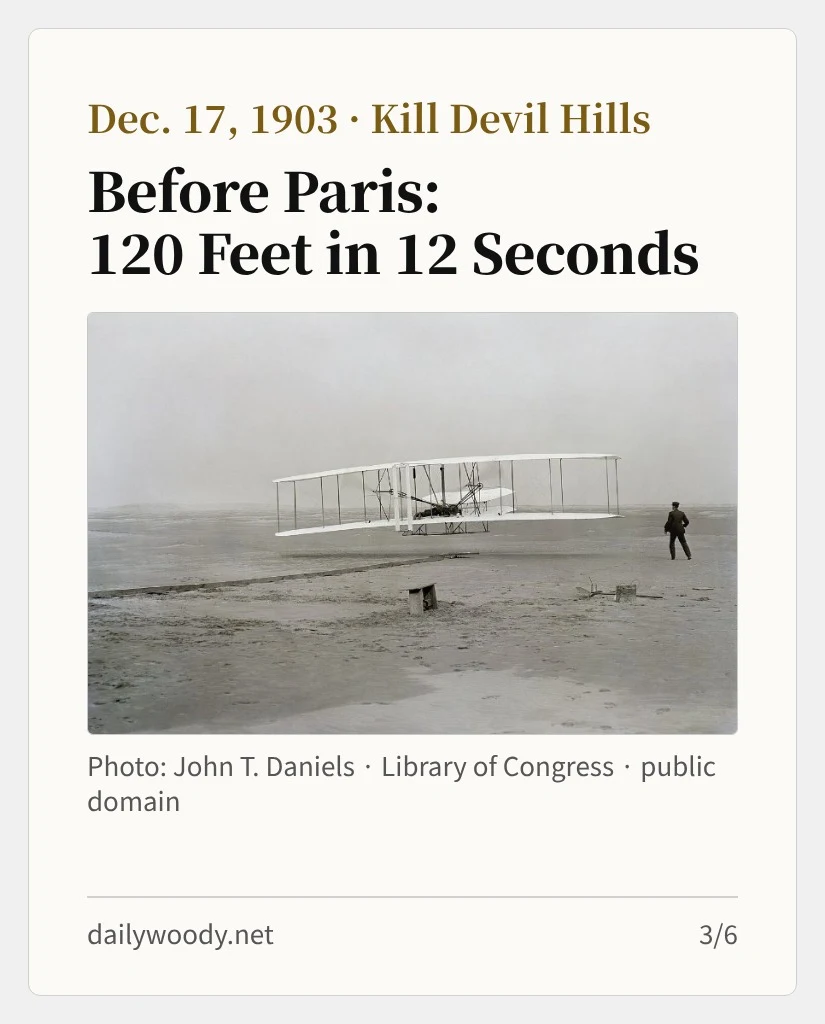
Most Americans would push back, and they would have the dates on their side. Orville Wright flew 120 feet in 12 seconds on Dec. 17, 1903, on the sand at Kill Devil Hills, North Carolina. Besides the brothers, five people watched. Two years later Wilbur stayed up for more than 39 minutes.
So why did Paris hand the prize to a man who flew about 200 feet? Think of the difference between batting practice and a game. A ball hit 500 feet in batting practice never reaches the record book. Only what happens in front of the official scorer counts. In Europe in 1906, the Aéro-Club was the official scorer, and the Wrights never came to the game.
1903: "Not in America"
The game itself was set up with the Americans in mind. In April 1903, the Chicago engineer Octave Chanute, a glider researcher who corresponded with the Wrights, described their glider experiments to the Aéro-Club in Paris.
Ferber heard about the talk and wrote to Ernest Archdeacon, a Paris lawyer and founding member of the club. A line from his letter ran that month in two French journals.
"The aeroplane must not be allowed to be perfected in America."
Archdeacon asked in print whether the homeland of the Montgolfiers, the brothers who launched the first hot-air balloon in 1783, would suffer the shame of letting the final discovery happen abroad. That year he and the club announced a silver cup for the first heavier-than-air machine to fly more than 25 meters. Santos-Dumont won that cup 120 years ago today.
The Wrights noticed. That June, Ferber angled for an invitation to their camp at Kitty Hawk to learn gliding. Wilbur cited the letter to Archdeacon as a reason to doubt his motives.
1905: A Cow Pasture Near Dayton
From 1904, the brothers practiced at Huffman Prairie, a pasture outside their hometown of Dayton, Ohio, owned by a family friend.
On Oct. 5, 1905, Wilbur circled the field for more than 39 minutes and landed only when the fuel ran out. He covered 24 miles. That is more than 1,500 times the distance Paris would certify a year later. The audience was a few invited friends and some local farmers.
In the language of the ballpark, the Wrights had hit the longest home runs anyone had seen, all of them in batting practice. Had they shown up for the game, nobody could have touched them. Instead, they stopped flying for two and a half years.
The Grounded Years
Their last flight of 1905 came on Oct. 16. They stopped because of a patent. They had applied in March 1903 for a "flying machine" whose key was a way to steer it: twisting the wingtips to bank left or right. A public flight before the patent came through would have shown rivals how to copy it. The patent was granted on May 22, 1906.
Even then, they kept the airplane hidden. They were negotiating sales with the United States and several European governments, and they would not show a flight, or even the machine, until a buyer signed. In late March 1906, a French commission traveled to Dayton and asked for a demonstration. The brothers said no.
It is hard to fault them. Defending a patent in court was slow and expensive, and a design, once seen, could not be unseen.
The cost was their reputation in Europe. French newspapers called them bluffers. On Feb. 10, 1906, the Paris edition of The New York Herald put the choice bluntly: either the Wrights had flown or they had not.
Into the empty ballpark that fall walked Santos-Dumont. His first attempt, on Sept. 13, ended in a hop of about 7 meters and a damaged airframe. On Oct. 23 he won the Archdeacon Cup. On Nov. 12 he flew 220 meters (722 feet) in 21.2 seconds and took the club's prize for the first flight of 100 meters. A stone marker at Bagatelle still says the world's first aviation records were set there that day.
1908: Le Mans
In March 1908, the brothers signed a contract with Lazare Weiller, a wealthy Frenchman, to form a syndicate that would build and sell their airplane in France. On Aug. 8, Wilbur made his first public flight in Europe at the Hunaudières racecourse near Le Mans. He circled the track twice. The talk of bluffing died away, and the brothers became famous overnight.
Wilbur kept flying near Le Mans until Dec. 31, setting record after record. The best hitter in practice had finally stepped into a game, and once he did, his old practice numbers became believable too. Europe now accepted that the brothers had been flying since 1903.
Washington's Label, 1918 to 1942
Washington, oddly, took far longer to get its own book right. From 1918, the Smithsonian Institution displayed an aircraft labeled as the first man-carrying airplane capable of sustained free flight. It was the Aerodrome, built by Samuel Langley, the Smithsonian's third secretary. Langley had tried it twice in 1903, and it failed both times. The Wrights flew nine days after the second failure.
The Aerodrome did not fly until 1914, after the Smithsonian handed it to the aircraft builder Glenn Curtiss, who modified it heavily. Curtiss was fighting the Wrights over their patent. Proof that an earlier machine could have flown would have weakened it.
Wilbur died in 1912. In protest, Orville sent the 1903 Flyer to the Science Museum in London in 1928. The Smithsonian did not retract its claim until 1942, in its annual report. Orville died in January 1948, and the Flyer came home that Dec. 17, on the 45th anniversary of the first flight.
From the day the label went up, it took Washington's official scorer 24 years to give the Wrights their due.
The Verdict, 120 Years On
Brazil still names Santos-Dumont the first aviator. Its scholars argue that the standard of the time asked for two things: a machine that took off on its own, and a set distance flown in public before experts. From September 1904, on days with little wind, the Wrights launched with help from a wooden derrick, about 20 feet tall, that dropped a heavy weight and pulled the airplane down a rail. The 1903 flights used no derrick, but they took off into a headwind of about 27 mph. Brazil's case leans on both the device and the wind.
Most historians outside Brazil disagree. Peter Jakab, curator emeritus at the Smithsonian's National Air and Space Museum, has called the argument that a launch device invalidates the Wright flights preposterous. Marion Weckerle of France's Air and Space Museum has said there is no doubt the Wrights flew before Santos-Dumont. The country that crowned Santos-Dumont now keeps a museum that sides with the Wrights.
The brothers who hit the longest balls in practice came late to the game, and the scorer at the game forgot to measure. Two countries look at the same sky and open record books from different years. Brazil reads the 1906 Paris book, where a scorer wrote down 25 meters. Most of the world reads the book revised after Le Mans, and even Washington needed until 1942 to get its own entry right. The Wrights flew first. Santos-Dumont was written down first. Records belong to whoever is keeping score.
Sources
- Source ↗ Puteaux municipal archives, "Vols de Santos-Dumont à Bagatelle" (Ferber's account)
- Source ↗ L'Histoire par l'image, "Santos-Dumont, le Brésilien volant"
- Source ↗ FranceArchives, "Premier vol soutenu en Europe"
- Source ↗ Britannica, "Santos-Dumont No. 14-bis"
- Source ↗ São Paulo State Legislature, "23 de outubro Dia do Aviador"
- Source ↗ Chanute-Wright correspondence, July 28, 1903, with editor's note
- Source ↗ Chanute-Wright correspondence, June 30, 1903, with editor's note
- Source ↗ ASME, "Wright Flyer III"
- Source ↗ AP via NBC News, "Ohioans mark centennial of 'practical' aviation" (2005)
- Source ↗ Smithsonian National Air and Space Museum, "So you've just invented the world's first piloted airplane, now what?"
- Source ↗ National Archives DocsTeach, Patent No. 821,393
- Source ↗ National Park Service, "What Dreams We Have," Chapter 8
- Source ↗ U.S. Centennial of Flight Commission, "1906"
- Source ↗ U.S. Centennial of Flight Commission, "Huffman Prairie, 1904"
- Source ↗ Taipei Times (Reuters), Dec. 11, 2003
- Source ↗ Smithsonian National Air and Space Museum, Wilbur Wright's first flight in Europe
- Source ↗ National Park Service, "The First Flight"
- Source ↗ HistoryNet, "Wright Brothers: A Promise of Flight Fulfilled"
- Source ↗ Wright State University Special Collections, "Series 5: Le Mans, France"
- Source ↗ Raymer and Oliveira, "Santos-Dumont: The first homebuilder" (AIAA, 2003)
- Source ↗ Smithsonian Libraries, "The Aerodrome A"
- Source ↗ Tom Crouch, "The Wright-Smithsonian Contract" (2013)
- Source ↗ Post Guam, "The Wright brothers invented the airplane, right? Not if you're in Brazil"
- Source ↗ Wikimedia Commons — Card 2 photo: Santos-Dumont’s 14-bis (Jules Beau, BnF, public domain)
- Source ↗ Wikimedia Commons — Card 3 photo: the Wright Flyer’s first flight (1903, John T. Daniels, Library of Congress, public domain)


댓글
댓글 쓰기