Annie Oakley, 100 Years On: When Reprinters Were Authors
Woody Magazine
We write the things that aren't news
Nov. 3, 2026 (Tue.)
Annie Oakley Died 100 Years Ago Today — In Her Day, Reprinting a Story Made a Paper Its Author
In 1903, one telegram with the wrong name in it led Annie Oakley to sue 55 newspapers. Thirty years later, an American court looked at the same kind of error and saw the newspaper differently.
At a Glance
This story in six cards.Swipe to see more →


On Monday, Aug. 10, 1903, a police officer stood before a magistrate in Chicago's Harrison Street police court and introduced the woman in his custody. She had been arrested on a charge of stealing a pair of trousers, he said, and she was the famous Annie Oakley of Buffalo Bill's show. The magistrate sent her to the city's house of correction.
The name belonged to the former star of Buffalo Bill's Wild West, the touring show of cowboys, riders and trick shooters. At 15, Oakley outshot a professional marksman in a match. She went on to spend 16 years with the show. Her signature stunt was shooting holes in a playing card tossed into the air. She died 23 years after that Chicago hearing, 100 years ago today, on Nov. 3, 1926, in Greenville, Ohio, the seat of the county where she was born. In Greenville, a foundation in her name issued commemorative playing cards this summer, and a local museum held a centennial talk in October.
The day after the hearing, the story was in newspapers across the country. Two of William Randolph Hearst's Chicago papers ran it first. The Publishers' Press, a wire service that supplied dispatches to member newspapers, telegraphed it to papers in other states. The papers said Oakley had stolen to pay for cocaine and that, at 28, she looked nearly 40. The real Annie Oakley was at home in New Jersey, two days short of her 43rd birthday.
The rest of the story is usually told as a morality play. A press baron invents a scandal, and a sharpshooter takes him to court. It is a satisfying version. But most of the papers Oakley ended up suing had simply printed a telegram from Chicago, and many of them had already run corrections and apologies.
One Telegram, 55 Newspapers
The correction came fast. The day after the story ran, the woman held in Chicago admitted she had given a false name, and the same wire service sent out a retraction. Her name was Maud Lee. Performing as Lillian Cody, she had toured Wild West shows as a sharpshooter, modeling her career on the woman she would now be mistaken for.
Oakley sued anyway. Between her first trial in 1904 and her last appeal in 1910, she took 55 newspapers to court, from St. Louis to Scranton and from Chicago to Charleston. She won or settled 54 of the cases.
The Argument in Mayville
Suing papers that had already printed corrections can look like overkill. That was exactly the argument in September 1906 in Mayville, N.Y., where Oakley sued the owner of the Dunkirk Herald. His lawyer conceded the article was libelous. The retraction had repaired the harm, he argued, and a paper so far from Oakley's home could hardly have hurt her much.
Oakley testified that she had been at home in New Jersey that August. In 21 years as a performer, she said, she had missed only five shows. Even if she had seen the retraction, she added, it would not have made much difference to her. A local paper described her in court as having the look of a "kindly school teacher." The jury awarded her $500.
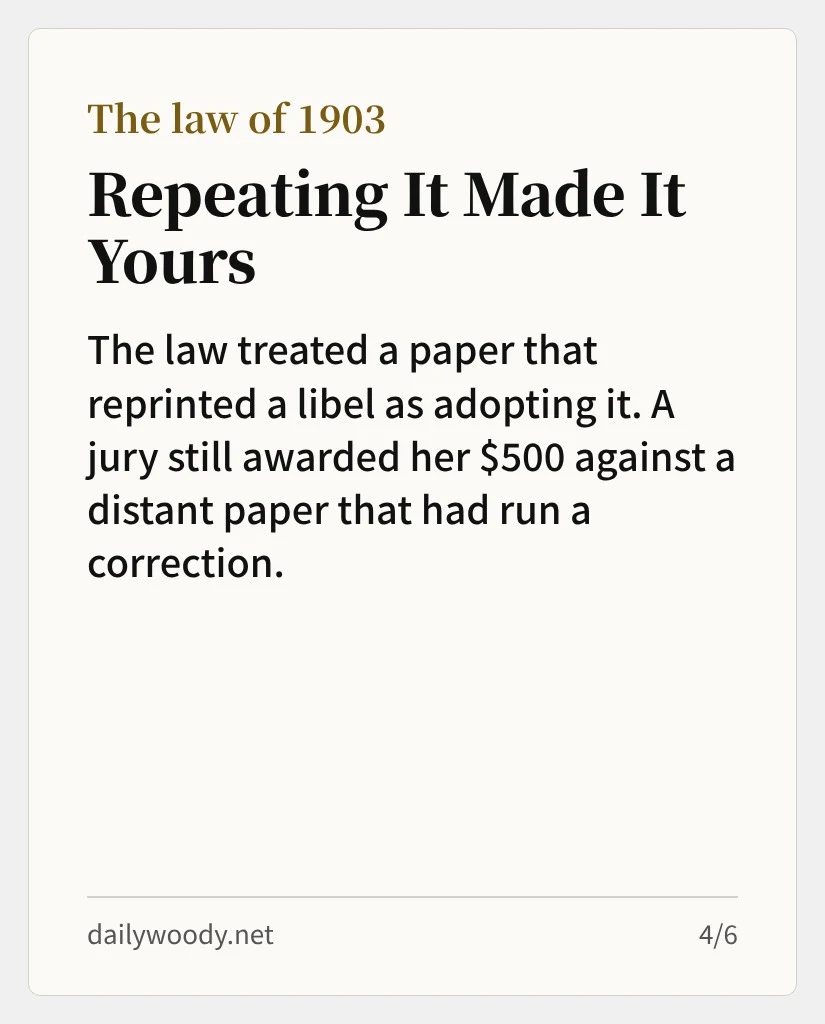
Why would a distant paper that had printed a correction still be held responsible? Under the libel law of the day, a person who repeated a defamatory statement was presumed to have adopted it as his own. A paper that printed a wire story unchanged stood where its writer stood. In 1905, a New Jersey court added a further line. Even when one item went out from Chicago to many papers, each paper answered only for the harm done through its own pages. To pursue the story everywhere it ran, Oakley had to take each paper to court on its own.
Think of a movie theater. Suppose one film plays in 55 theaters and casts an innocent stranger as a thief. The law of 1903 treated every theater as though it had made the film.
Oakley's paper-by-paper approach found its way into the legal literature. In the late 1940s, a note in The University of Chicago Law Review said Oakley was credited with inventing this tactic: suing in many places over a single wire dispatch.
Florida, February 1933
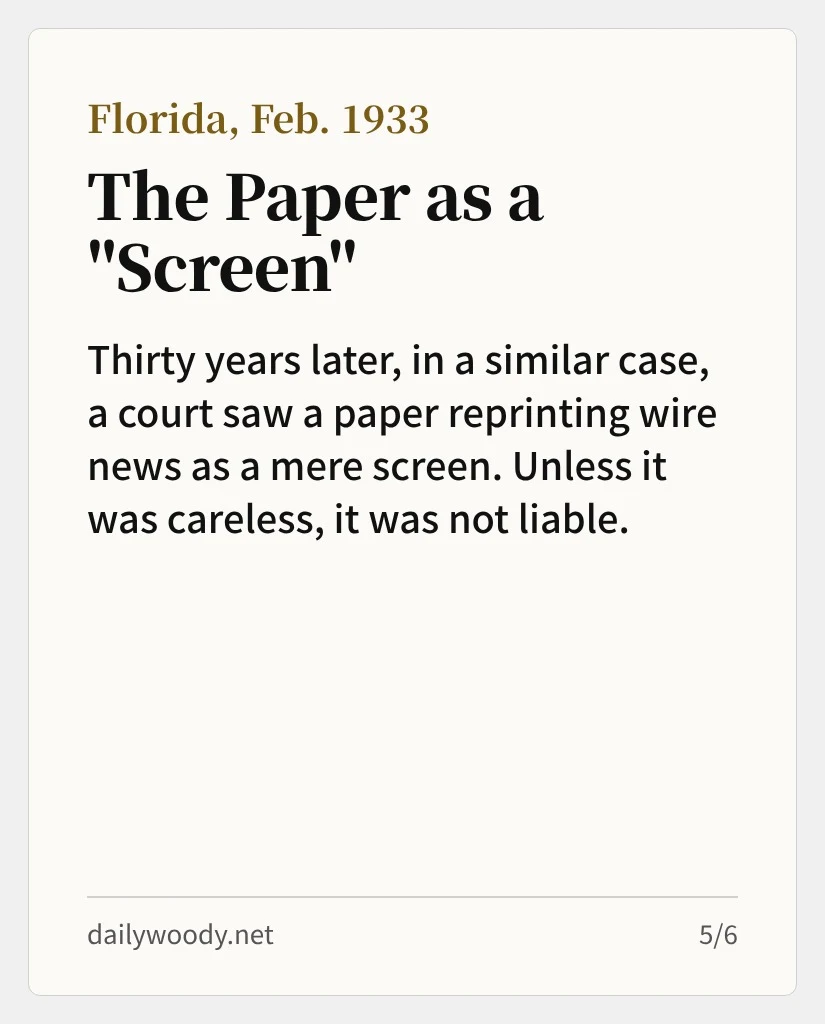
Thirty years later, a case with the same shape reached the Florida Supreme Court. In the summer of 1930, The Tampa Morning Tribune printed two Washington dispatches, one from The Associated Press and one from Universal Service. They reported that a congressman had been indicted for possessing liquor during Prohibition, and that his secretary had been indicted with him. One dispatch named the secretary as John Layne. Layne sued the paper for $15,000. The court proceeded on the assumption that the report about him was false.
The instinct is to blame the paper for not checking, and the instinct is reasonable. Yet on Feb. 3, 1933, the court sided with the Tribune. No newspaper, the justices wrote, could verify every item a news agency sent and still publish on time. Courts had a duty, they added, to fit old rules to the conditions of a "mechanized era."
A paper reprinting a wire dispatch, the court held, was "simply acting as a local 'screen'" for news written by others. (Layne v. Tribune Co., 1933)
Did that leave Layne with nothing? The court left a door open. A plaintiff could still win by showing that the paper had acted recklessly or carelessly. And the court treated the agencies that wrote and sent the dispatch as the real authors. Many state courts later adopted the reasoning, which lawyers now call the wire service defense.
From Author to Screen
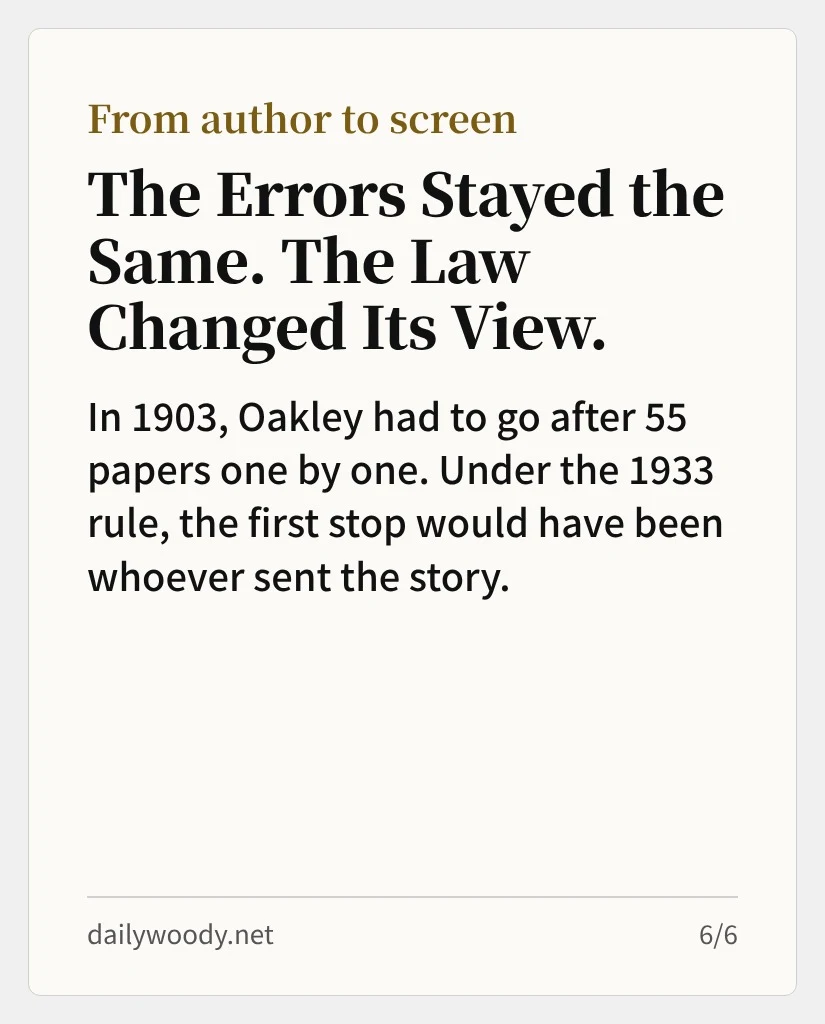
The two cases mirror each other. In both, a wrong name ended up in a story about an arrest or an indictment. In both, the story traveled by telegraph into local papers. The law of 1903 treated those papers as authors, and the court in 1933 treated them as screens. Across 30 years, the errors looked the same. What changed was how the law saw the newspaper.
The 1933 opinion does not mention Oakley's suits. But the rulings of the two eras turned on the same question. Is a paper that reprints someone else's story the speaker, or the screen?
In 1903, the law held every theater responsible for the film it showed. In 1933, a court decided the theater was only a screen. How the law saw the theater decided where the owner of a wrong name had to go. Under the 1933 rule, that would usually have been the studio that made the film. In 1903, Oakley had to go to 55 theaters.
Sources & References
- Source ↗ Butler v. Hoboken Printing & Publishing Co. (N.J. 1905)
- Source ↗ Layne v. Tribune Co. (Fla. Supreme Court, 1933)
- Source ↗ Michelle Henry, "Annie Oakley in Court", New York Archives, Fall 2008
- Source ↗ Smithsonian Magazine, How Annie Oakley, "Princess of the West," Preserved Her Ladylike Reputation
- Source ↗ HistoryNet, Annie Oakley vs. Hearst's Worst
- Source ↗ PBS American Experience, "Annie Oakley" program transcript
- Source ↗ The University of Chicago Law Review, Recent Cases: Libel and Slander (note on Spanel v. Pegler)
- Source ↗ Jennifer L. Del Medico, "Are Talebearers Really as Bad as Talemakers?", Fordham Urban Law Journal 31 (2004)
- Source ↗ Jerry Kuntz, A Pair of Shootists (University of Oklahoma Press, 2010)
- Source ↗ Garst Museum, Victorian Tea honoring Annie Oakley (2026)
- Louis Stotesbury, "The Famous 'Annie Oakley' Libel Suits", The American Lawyer 13 (1905)
- Kyu Ho Youm, "The Wire Service Libel Defense", Journalism Quarterly 70(3) (1993)
댓글
댓글 쓰기