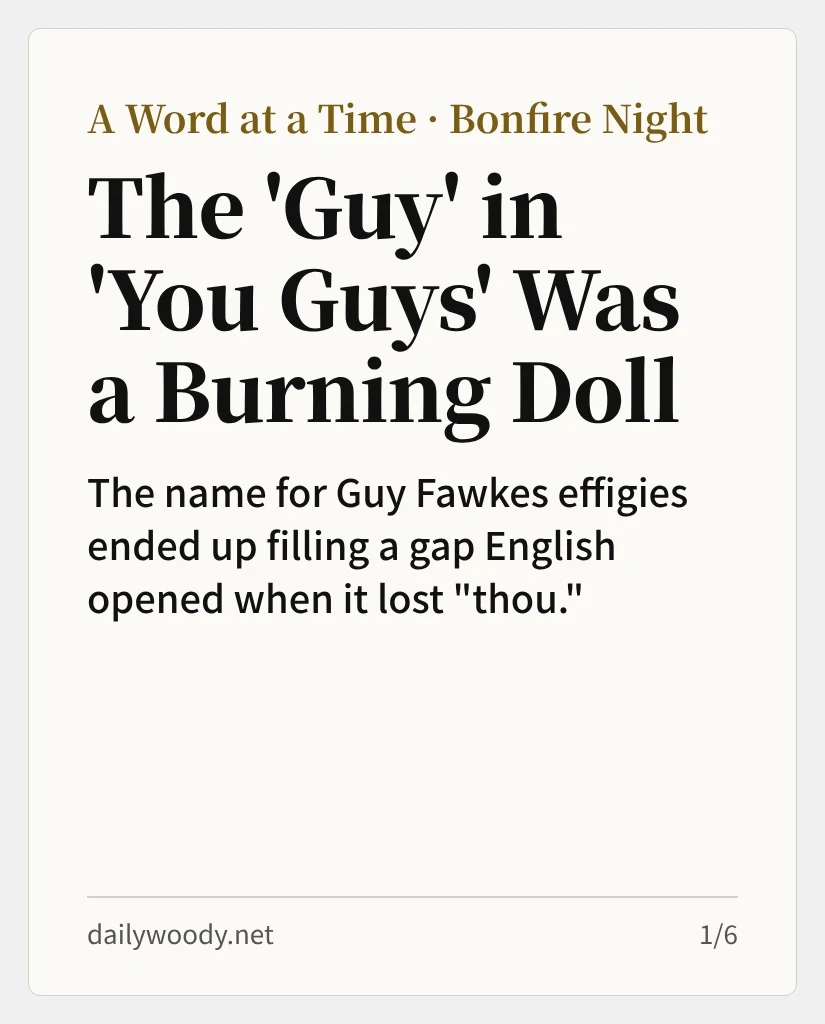
Bonfire Night: The 'Guy' in 'You Guys' Was a Burning Doll
Woody Magazine
We write the things that aren't news
Nov. 4, 2026 (Wed.)
Bonfire Night: Before 'You Guys,' a Guy Was Something You Burned
How a straw effigy of England's most famous plotter ended up filling a hole in English grammar
At a Glance
This story in six cards.Swipe to see more →


Around midnight on Nov. 4, 1605, a search party opened a storeroom beneath the House of Lords in London. Behind a pile of firewood sat barrels of gunpowder. Beside them stood a man who said his name was John Johnson. He had fuses in his pockets.
His real name was Guy Fawkes. That was 421 years ago tonight.
The plan had been simple. England's Protestant king, James I, would open Parliament on Nov. 5, with the Lords and Commons gathered together. A small group of Catholics, angry at the persecution of their faith, meant to kill them all at once.
The ringleader was Robert Catesby. Fawkes, a soldier who had fought for Spain in the Netherlands, was recruited because he knew how to handle gunpowder. A fellow plotter, Thomas Percy, rented the storeroom, and Fawkes posed as his servant.
An anonymous letter warning a Catholic peer to stay away from Parliament gave the scheme away. Fawkes was tortured, tried and executed before the end of January 1606.
Catesby planned it. The name people remember belongs to the man caught standing next to the powder. Even the white, mustached mask that protesters wear, made famous by "V for Vendetta," is his face, redrawn by the comics artist David Lloyd.
In January 1606, Parliament ordered churches to hold special services every Nov. 5 as a day of thanksgiving. At night, people lit bonfires. The figure placed on those fires came to be called a guy. It is the same guy you hear whenever someone opens a video with "Hey, guys."
It's tempting to assume the villain was so notorious that his first name simply stuck. That makes for a tidy story. But between the man and the modern word sits a straw doll. And that doll's name would eventually take a seat English had left empty for a very long time.
A Name for a Doll
The Oxford English Dictionary's earliest record of the word guy dates from 1806, and it is already about a person. In a letter, a young William Burrell wrote that a month earlier he had looked such a wreck that "no guy ever matched me."
Men in Rags
Guys were usually made from cast-off clothes stuffed with straw or rags. See enough of them each November, and a badly dressed man starts to look like one. It is easy to see how the word became an insult. The OED records that sense from 1836.
Allan Metcalf, a linguist and former executive secretary of the American Dialect Society, places it earlier. In his 2019 book "The Life of Guy," he finds "guys" used for men of the lowest sort early in the 18th century.
In 1851, the journalist Henry Mayhew, who was documenting London's poor, met a boy who went out with a guy every Nov. 5. When he was very small, the boy said, he had been carried through the streets as the guy himself. He wore a mask. Once, other boys took him for a stuffed guy, punched him in the eye and snatched the mask off his face.
"I've had enough of being guy; I don't be guy any more."
A boy interviewed by Henry Mayhew, "London Labour and the London Poor" (1851)
When the BBC's "Sherlock" left John Watson trapped at the bottom of a Guy Fawkes Night bonfire in 2014, the scene had a Victorian precedent. The children in that episode who ask for "a penny for the guy" were borrowing a real custom, too. Kids once wheeled homemade guys around town to raise money for fireworks. The London Museum says the custom had faded by the end of the 20th century.
A few years before Mayhew met that boy, the word had already started to soften. In 1847, the OED records guy meaning simply a man or a fellow.
Burning the Pope in America
Even in England, Fawkes was never the only one on the fire. Effigies of the pope burned beside him, along with whichever public figures were hated that year.
When Nov. 5 crossed the Atlantic, the colonies called it Pope Day, and the effigy on the fire was usually the pope.
On Nov. 5, 1775, George Washington, then commanding the Continental Army, condemned "that ridiculous and childish Custom of burning the Effigy of the pope." He was trying at the time to win French Canadian Catholics to the patriot cause. Pope Day faded in the decades that followed.
Yet it was in America, where the bonfire held the pope more often than Fawkes, that the word really caught on. Merriam-Webster notes that in the U.S. guy came to mean simply "man" and, in time, a person of either sex.
The Pronoun English Lost
A new word for a man does not, on its own, produce "you guys." For that, English needed a gap.
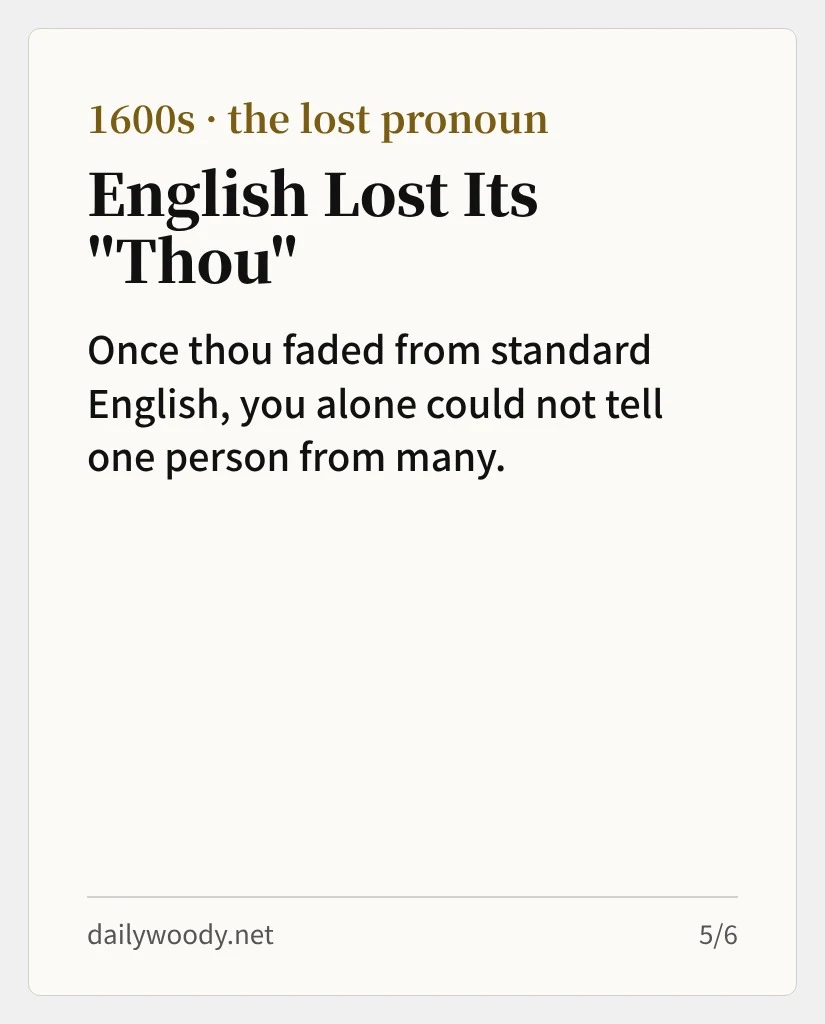
Early English had two second-person pronouns: thou for one person, ye or you for several. By the 13th or 14th century, probably under French influence, speakers had begun using you for a single person as a mark of respect. French still works this way with vous.
The more ground you took, the more thou shrank to intimates and inferiors. By the 17th century it had all but vanished from standard English.
Anyone who has asked a table of three, "Can you help me?" knows the problem. One person or all of them? Merriam-Webster notes that speakers clearly felt the loss. English speakers have lived with that question ever since.
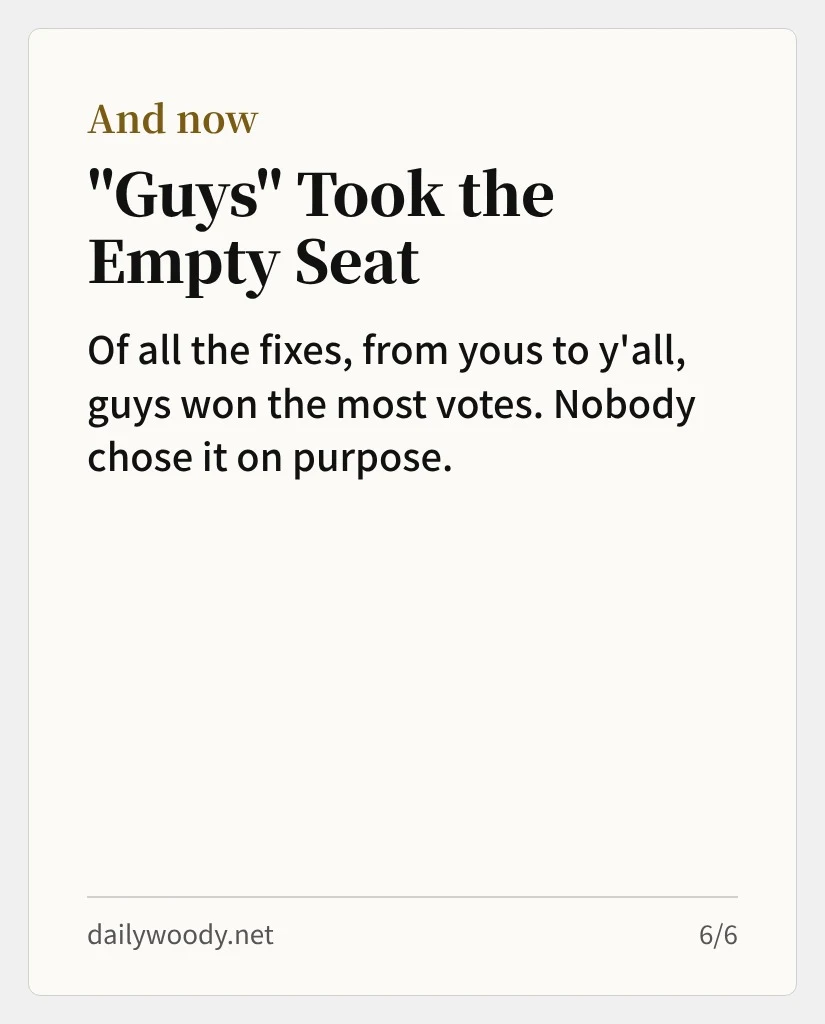
For more than two centuries, they tried patches. They added an s to get yous and youse. They tried you folks and you-uns. Only y'all took root, mostly in the South, and none became standard.
If fame were the reason, the name would not have needed three centuries to reach the pronoun. English already had plenty of words for a man, fellow and chap among them. So why guy? Metcalf doesn't offer a neat answer. He argues that every time we speak, we cast a vote for words, and "guys" simply won the most votes. The summary of his book notes that none of these changes happened deliberately.
Girls Who Said 'Guys'
In the 20th century, guy shed its ties to class and clothing. Any male, from infant to old man, could be one. The plural went further.
Metcalf's early example comes from Edna Ferber's 1911 novel "Dawn O'Hara." A male journalist addresses a group of five reporters, one of them a woman, as guys. The OED has a 1932 example of a girl telling her friends, "Come on, guys." By midcentury, women were using "you guys" to address groups of anyone.
There is a fair objection that guy still means a man, and people keep proposing alternatives. None has yet caught on widely enough to replace it.
York
Fawkes was born in York in 1570 and attended St Peter's School there. The school holds fireworks on Nov. 5, but by its own account it has never burned his effigy.
Metcalf reported in 2019 that people in York now say "you guys," though the phrase had been unheard there two decades earlier. In the city whose old school refuses to burn the guy, people greet their friends with its name.
Nobody chose "guys." English lost any way to tell one you from many, and the seat stayed empty for more than two centuries. A name hauled through the streets every November happened to be nearby. Empty seats don't check who sits down.
Sources
- Source ↗ English Heritage, "Bonfire Night"
- Source ↗ National Portrait Gallery, "Gunpowder, Treason and Plot"
- Source ↗ Founders Online, National Archives, "General Orders, 5 November 1775"
- Source ↗ Allan Metcalf, "The Surprising Origins of the Phrase 'You Guys,'" TIME, Sept. 30, 2019
- Source ↗ Allan Metcalf, "The Life of Guy," Oxford University Press, 2019
- Oxford English Dictionary, "guy, n.2"
- Source ↗ Online Etymology Dictionary, "guy"
- Source ↗ Merriam-Webster, "guy"
- Source ↗ Merriam-Webster, "you"
- Source ↗ Grammarphobia, "You guys and dolls"
- Source ↗ Henry Mayhew, "London Labour and the London Poor," Vol. 3 (1851), Tufts Digital Library
- Source ↗ London Museum, "Penny for the Guy?: A lost Bonfire Night tradition"
- Source ↗ St Peter's School, York, "Guy Fawkes Fireworks Night 2024"
- Source ↗ PBS Masterpiece, "Sherlock: The Empty Hearse"
- Source ↗ Britannica, "Gunpowder Plot"
- Source ↗ Design Week, "Behind the Anonymous mask"
댓글
댓글 쓰기